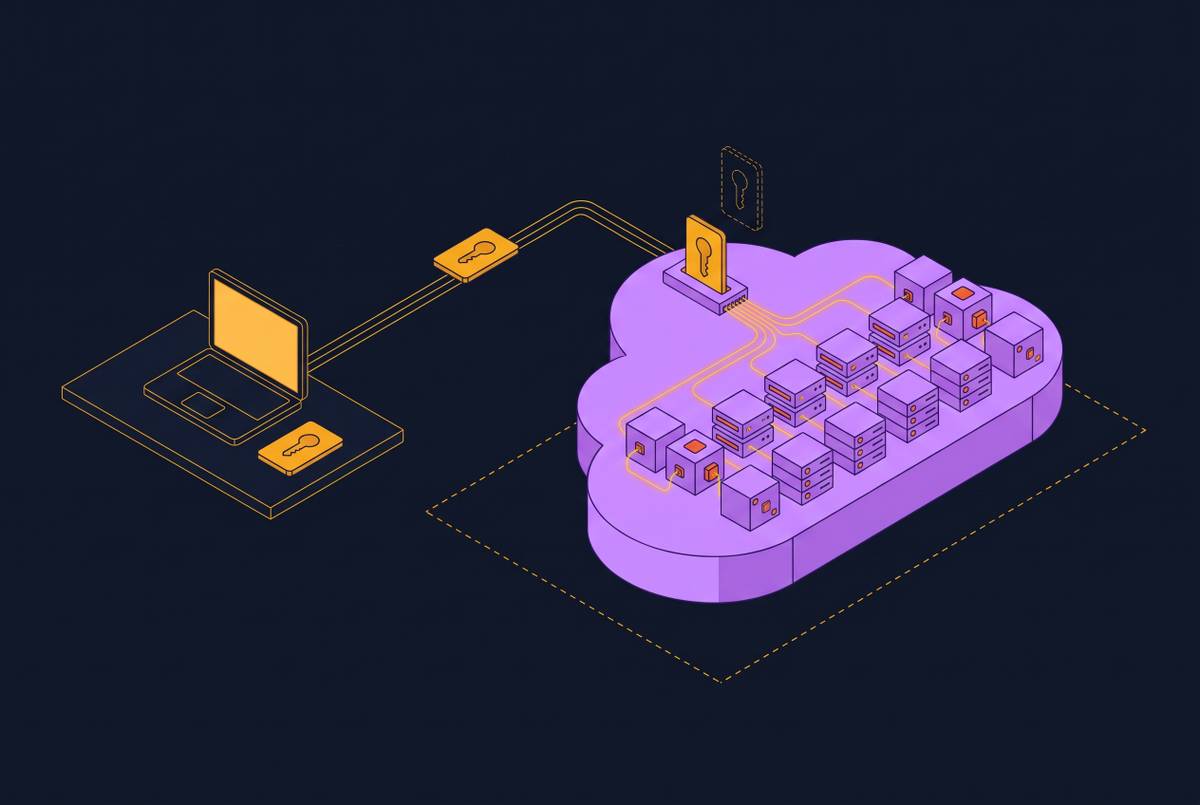
What Engineering Teams Actually Pay to Avoid Running Agent Infrastructure Themselves
Managed platforms hide four cost categories that self-hosted teams must budget separately.
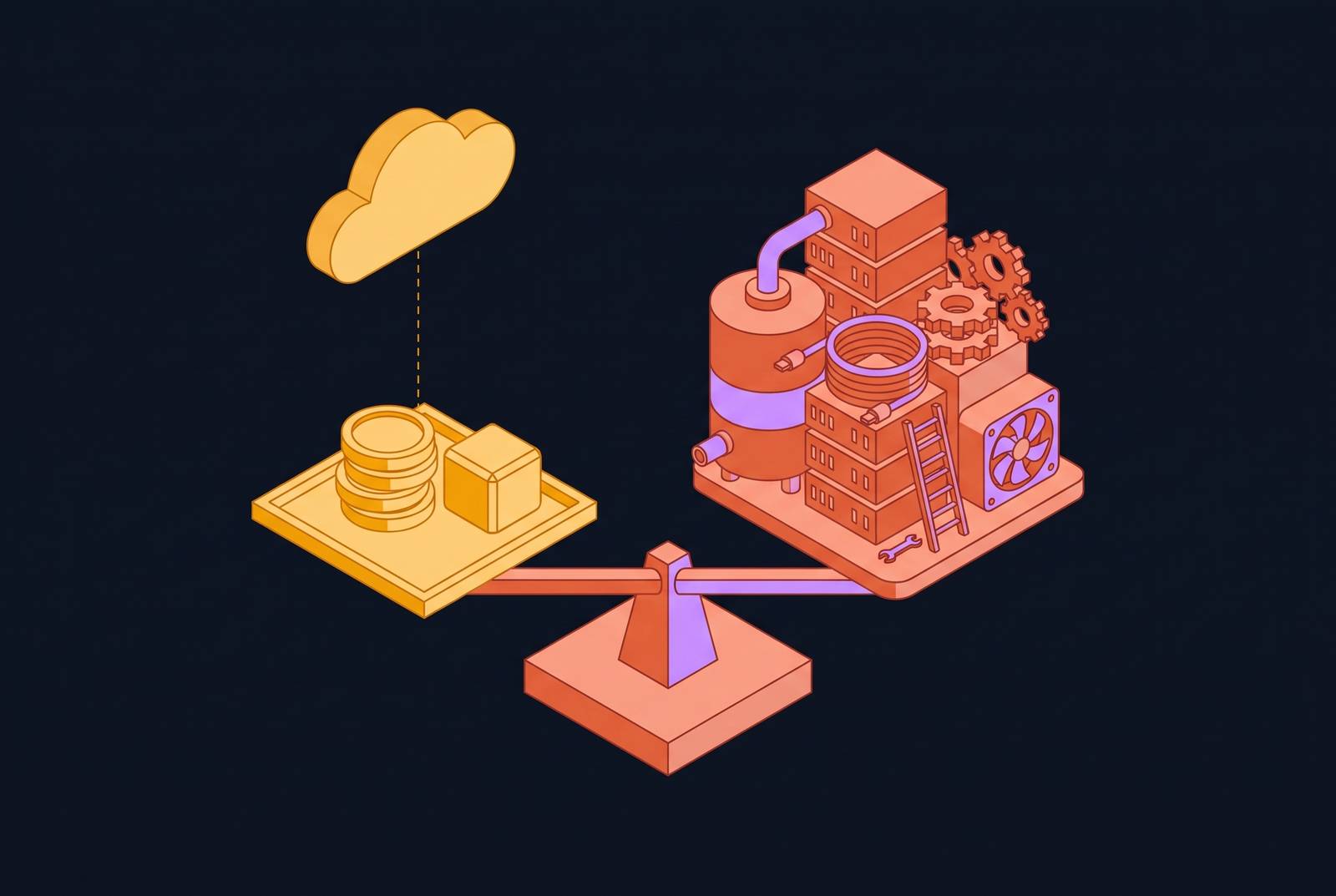
The best cloud coding agents for engineering teams have infrastructure, attribution, and harness flexibility that fit the team’s workload as well as its subscription budget. Managed platforms let teams run agents without having to build their own sandboxing, orchestration, and environment setup. The build-vs-buy decision thus depends on what it costs to replace and maintain those capabilities as well as what compute costs.
Why the managed-vs-self-hosted decision is harder to make than it looks
The apparent choice is between paying a monthly fee and running agents internally. The actual comparison spans four cost categories, namely burst provisioning, per-agent isolation, environment maintenance, and usage unpredictability. These costs sit beneath three operational layers, which are sandboxed compute, model API access, and an orchestration harness. Buying model access does not supply the other two.
The gap becomes apparent when a team moves beyond a handful of concurrent agents. The infrastructure a team already has may work well for long-running services but struggle with environments that appear in bursts and disappear right afterward. Meanwhile, managed pricing obscures how much work a subscription actually buys. Understanding the billing units comes first, followed by the infrastructure obligations and the instrumentation needed to compare them.
What the sticker prices on managed agent platforms actually measure
Managed agent subscriptions can look alike even when they charge for different units. OpenAI Codex uses token-based pricing, with Free, Go, Plus, Pro 100, Pro 200, and Pro 500 tiers as of October 18, 2026. Those tier names do not establish a comparable per-task price. Consumption still determines the cost of the work.
Cursor stopped selling its previous entry-level plan to new subscribers as of October 2026. Since October 12, 2026, new customers buy through SpaceXSI’s X Subscription, with Plus, Premium, Super, and Ultra tiers at escalating price points. Plus includes Grok models only. Devin instead prices Core as monthly pay-as-you-go usage per ACU, roughly a quarter-hour of active work, while Team charges a higher monthly flat rate with bundled ACUs.
Google Jules offers Free (Standard), Google AI Pro at $19.99/month for approximately 75 daily tasks, and Ultra at a substantially higher monthly rate for 300 daily tasks in the June 7, 2026 pricing details. These allowances measure something different again. Copilot’s base price pays for credits, a Cursor seat comes with a usage allowance, Claude Code’s Max tier has a rolling time-window limit, and Codex charges for what teams use. A comparison of subscription prices alone leaves the denominator unresolved.
How usage behavior — not plan tier — drives the real monthly bill
How much teams spend depends on their concurrent sessions, which models they choose, and their agent loop depth. Parallel Claude Code sessions each draw from the same plan at the rate of interactive work, without an agent discount or volume pricing. More sessions consume quota proportionally faster. The subscription does not become more economical simply because work runs unattended.
Model choice changes that consumption’s price substantially. GitHub Copilot’s per-token rates as of June 1, 2026 include GPT-5 mini at $0.25 input per million tokens, with Claude Sonnet 4.6 and Claude Opus 4.7 at significantly higher rates. Opus charges several times more for output tokens than input, making code-heavy generation particularly consequential. One Opus 4.7 orchestrator with four Sonnet 4.6 workers costs substantially less than five Opus agents.
A task requiring more tool calls can cost more even when the model stays unchanged. With Copilot’s pooled credits, heavy users can also use up allowance that would otherwise be left for lighter users. Without visibility into sessions, models, and task execution, independent engineer choices create costs that teams cannot measure or manage.
The burst provisioning problem that managed platforms absorb quietly
Self-hosted compute must accommodate bursts above steady-state demand. Engineers running several agents each can require dozens of isolated environments simultaneously, followed by rapid teardown. A fixed cluster cannot simply be right-sized around that pattern. Capacity either waits idle or needs a fast way to appear.
Standard VMs take minutes to provision, while Kubernetes pods require additional orchestration and isolation configuration. Five tool calls at 50ms each complete in 250ms, whereas the same steps in a 1.5-second sandbox take over seven seconds. That delay can break the reasoning chain and force broader, less precise diagnostics.
Claude Code cloud sessions start with common toolchains and services installed, while Codex installs dependencies during an internet-enabled setup phase and publishes the prepared filesystem for subsequent tasks. Both reclaim idle environments so teams pay only for active time. Replicating that behavior internally requires significant over-provisioning or investment in snapshot and restore infrastructure. Neither is a simple compute purchase.
What per-agent isolation actually requires, and why shared environments fail
Provisioning enough environments ensures only that sufficient capacity is available. Each task also needs its own filesystem, network namespace, and compute allocation because agents install packages, run services, drive browsers, and execute shell commands. Shared execution creates lateral movement risk between tasks and users. Isolation allows a team to trust that an agent working on a production branch cannot interfere with another working on a different service.
Claude Code cloud sessions run in a fresh Ubuntu 24.04 VM per session. Teams cannot open a shell directly in that VM, and the platform reclaims it on idle. Codex likewise runs each task in its own VM, rebuilt from a prepared snapshot, with saved state available for up to seven days after the last turn. These boundaries are mandatory parts of the execution model.
Shared containers do not give teams the same guarantee by default. A self-hosted team using a single Kubernetes namespace or shared Docker host must add network policies, filesystem separation, and privilege boundaries. Runtime dependencies also need separation when one agent works on Python 3.11 and another on Node 20. As concurrency grows, maintaining those boundaries becomes a continuing security obligation.
The environment configuration work that managed platforms pre-load
An isolated machine is not yet a useful development environment. Every session needs the appropriate dependencies, toolchains, credentials, and configuration, and that set changes with the team’s stack. Claude Code supports setup scripts whose installed files are cached for approximately seven days, plus configurable environment variables and network access levels. Its pre-installed PostgreSQL and Redis are not running by default, illustrating the distinction between supplying a tool and preparing it for work.
Codex inspects repositories, installs dependencies and tools, and tests the workflow before publishing the environment. That moves validation ahead of task execution. Self-hosted equivalents require base images or snapshot definitions that track dependency updates, service changes, and new tooling. An agent unable to install a package or run the test suite cannot reliably verify its output, regardless of model capability.
Ramp’s Inspect shows how extensive that environment can become. It runs in sandboxed virtual machines on Modal and works with databases, CI/CD pipelines, Sentry, Datadog, feature flags, Slack, and GitHub. Coinbase’s Forge works across Slack, GitHub, and Linear, using Linear to build context before a task starts.
Usage unpredictability and why flat-rate plans do not solve it for teams
Maintaining those environments does not remove workload variance. Flat-rate and usage-based plans change where that continuing variance appears. A ten-person Copilot Business team has a $190/month base, but heavy agent use can exhaust pooled credits and produce overages that bring per-person spending to multiples of the sticker price. The base payment is not the full budget.
Only base credits are contractually guaranteed. Planning around the total allowance therefore exposes teams to reduced effective capacity without a plan change. Flat-rate packaging can conceal variability in available work as well as in eventual spending.
Codex makes variance visible through token consumption without an artificial usage limit. A runaway loop continues consuming tokens and producing a bill. Self-hosting does not remove this workload behavior, because model consumption and execution still need accounting. Rate limiting alone cannot explain the cost or the output. To explain that, teams need observability that links each run to its task, model, how long it took, and its result.
What attributing agent work actually requires and why it matters for the build-vs-buy calculation
Attribution must connect the harness and model to an assigned task, runtime, output, and consumed credits or tokens. A pull request, a failure, and a partial result are different outcomes even if they use about the same resources. Aggregate usage cannot distinguish their value. Without that distinction, teams compare what they think self-hosting will cost with managed spending they cannot fully explain.
Doctolib, with roughly 900 tech and product staff, ran A/B tests comparing Opus 5.5 and Sonnet 5 on agent-generated pull requests. It found that Opus 5.5 gave clearly better results at a much lower cost per pull request, so it changed its policy for choosing models. The finding depended on per-PR attribution. Token prices alone would not have exposed the relationship between model choice and completed work.
Linear embeds an attribution chain in its workflow, with Claude Code or Codex opening draft PRs and a human engineer reviewing and approving them. Ramp’s Inspect reached over 50% of PRs merged to production monthly without mandated adoption, supported by visibility into tasks engineers could trust it to handle. To get the same level of attribution, self-hosted teams need instrumentation across the harness, model API, and CI/CD pipeline. For managed buyers, analytics down to source, harness, model, and credential should be a required selection criterion.
Which cloud coding agents fit engineering teams without locking in harness or model choice?
Attribution also gives teams a basis for changing agents when performance changes. A platform restricted to one harness can prevent that adjustment even if its infrastructure works well. The late-2026 landscape contains distinct strengths. Claude Code is ahead on terminal-native refactors and multi-file architectural reasoning, and Claude Opus 4.8 reached 88.6% on a software engineering benchmark.
OpenAI Codex leads Terminal-Bench with GPT-5.5 and offers native Slack and Linear integrations for triggering cloud tasks without opening a terminal. Cursor works as a daily IDE driver and uses far fewer tokens for small surgical edits, but it uses far more than Claude Code on large-repo autonomous runs. Benchmark leadership has also shifted repeatedly as models ship.
Trigger integrations need the same precise comparison. Codex provides the named Slack and Linear integrations, while Coinbase’s internally built Forge can be called from Slack, GitHub, or Linear. Forge demonstrates what an internal-only implementation can connect. The appropriate managed-platform posture is harness-agnostic, accepting work from systems such as Slack, Linear, GitHub, and GitLab and returning pull requests, recordings, or replies. Otherwise, accessing a better-fitting agent may require leaving the platform itself.
Assembling the full cost stack: what teams are actually paying for when they avoid building it themselves
Burst provisioning takes weeks of engineering work, while isolation needs infrastructure that has had a security review beyond what the default Kubernetes configuration provides. Environment definitions need continuing maintenance as dependencies and tooling change. Attribution requires a data pipeline across execution and delivery systems. Harness flexibility also means teams must support changes of agent without rebuilding the workflow around them.
These obligations interact at team scale. More concurrent agents increase provisioning demand and the number of boundaries to maintain, while more models and harnesses expand the instrumentation needed to explain results. Engineering time spent on that stack competes with product work. Managed platforms make that time avoidable only to the extent that they actually supply the capabilities a team needs, so the comparison must verify the features delivered with the subscription.
Observed workload data makes the decision legible. Cost per useful output, session behavior, environment maintenance, and the engineering time replaced provide a stronger basis than headline prices. Teams with substantial infrastructure capacity and specific security or compliance requirements may legitimately choose self-hosting. Teams focused on product development will generally find managed spending more defensible once the replacement work is priced honestly.