Using Claude Max or Codex Pro Inside a Cloud Agent
Choosing Claude Code or Codex means picking a session architecture for agent work.
A cloud agent works through a long refactor, but then it hits a rate limit at hour three. It doesn't pause politely and wait for a human to notice. It abandons the task mid-stream, leaves behind a partial pull request, or stops in a state that forces a full restart from scratch. That is the real subject of this article: the subscription tier a team picks for Claude Code or Codex is an infrastructure contract that shapes whether autonomous work actually finishes. When a developer hits a limit while typing into a terminal, it's an annoyance, a few minutes lost waiting for a reset. When a cloud agent hits that same limit unattended, the failure is structural and can cost hours of work. Two harnesses dominate the cloud agent landscape in 2026, Claude Code from Anthropic and Codex from OpenAI, and each wires its subscription tiers into session behavior in a different way. Choosing between them means choosing a session architecture, not just a price point.
Claude Code's plan structure and session capacity, pooling, and parallelism
Claude Code's tiers are sorted by how much work can run in a given window, how many sessions can run at once, and whether that capacity is shared with everything else happening on the account. As of August 2026, Anthropic's published pricing lays out four tiers. Pro, at $20 a month, is the entry point: Claude Code is included, and usage is metered in five-hour rolling sessions with a weekly cap stacked on top. Team Standard runs $20 per seat per month on an annual contract, and it includes Claude Code on every seat, plus a session allowance above the Pro baseline. Team Premium costs $100 per seat per month annually and gives each seat five times the usage of a standard seat, so it's the easiest way to equip a whole team without negotiating an Enterprise contract. Enterprise is priced on request, billed per seat with consumption charges layered on top, and adds SSO, a compliance API, and custom data retention.
The table matters less than what sits underneath it. A single usage pool is what every account on a Claude plan draws from. Claude Code sessions, the desktop app, the web interface, and ordinary chat conversations: they all pull from the same allowance. A morning spent chatting with Claude about an architecture decision reduces, hour for hour, how much agent capacity remains that afternoon. On top of that shared pool, two separate limits stack: a five-hour session cap and a weekly cap that resets on a fixed schedule. Even on a low tier, one heavy cloud agent run can burn through the weekly budget before the rest of the week's work has even started.
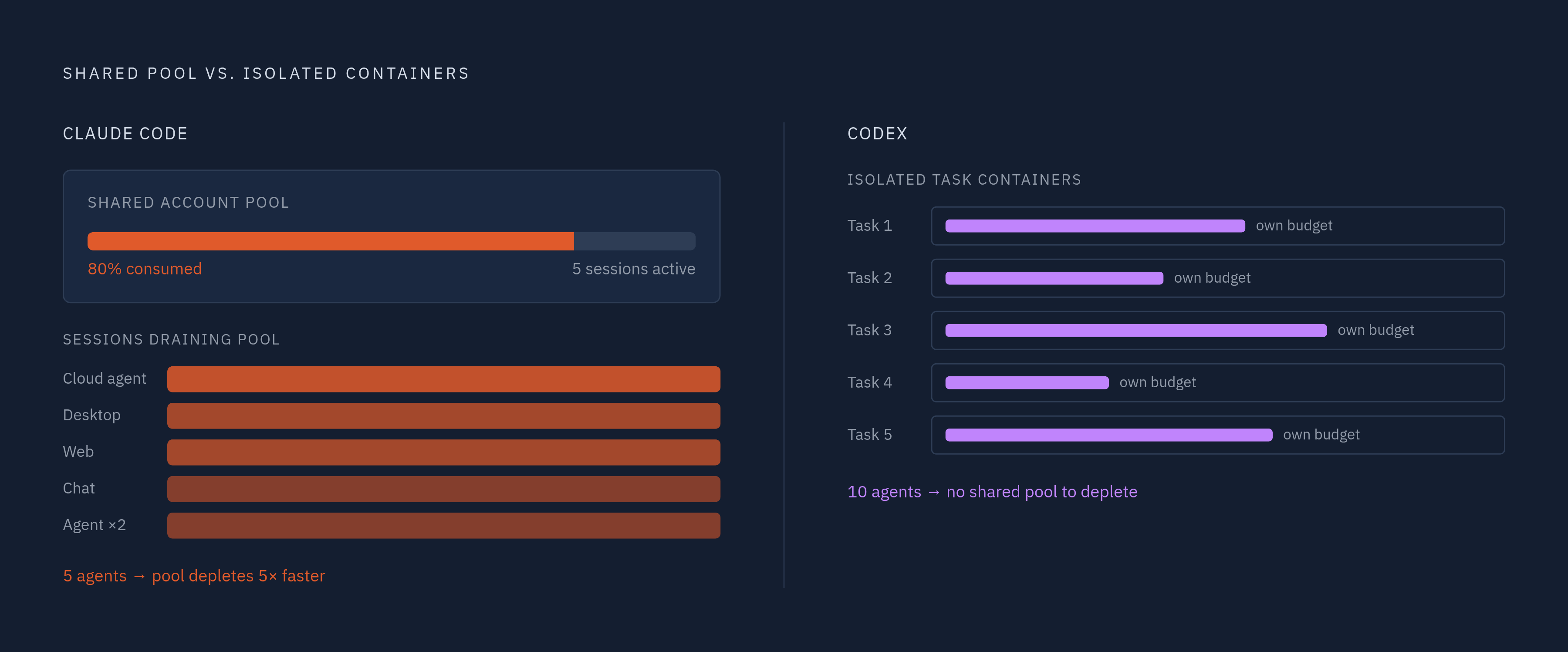
Anthropic has moved to loosen this constraint. On May 6, 2026, the company doubled Claude Code's five-hour rate limits across Pro, Max, Team, and seat-based Enterprise plans, and removed the peak-hour throttling that had previously slowed Pro and Max users during business hours. That matters for teams running agents during the workday, when usage concentrates there during those hours. Claude Code cloud sessions, started with the claude --cloud command, each run in an isolated, Anthropic-managed virtual machine, and several can run side by side. But parallelism here doesn't come free: every one of those sessions shares the same account rate limit, so running five agents at once burns the pool five times faster, not at some fixed rate per session. The ceiling is the same whether work happens in one session or ten; the tier just determines how high that ceiling sits.
Codex's subscription model
Codex solves the same underlying problem, keeping cloud agent work reliable within a subscription, by starting from the opposite architectural premise. Rather than giving a developer a pool of capacity to spend across however many sessions they choose, Codex organizes its agent work around discrete, delegated tasks, each one running in its own isolated container. Every Codex task runs in an OpenAI-managed container preloaded with the target repository, and the runtime inside that container moves through two phases: a setup phase with network access, used for installing dependencies, followed by an agent phase that runs network-isolated by default once the actual coding work begins.
Each task gets its own sandbox, so Codex can run multiple coding tasks at the same time, and those tasks never compete for a shared session budget the way simultaneous Claude Code cloud sessions do. The parallelism model here is a task queue, not a session pool, and that distinction has a direct consequence: running ten Codex tasks in parallel doesn't degrade a shared weekly allowance the way ten simultaneous Claude Code cloud sessions would draw down a single account's rate limit. Each task's saved virtual machine state stays recoverable for up to seven days after its last turn, letting a follow-up request resume a task. That recoverability comes with a tradeoff: Codex has no persistent session construct to resume in the first place, which simplifies its isolation model, but any mid-task state recovery on a cold container still means picking the work back up essentially from scratch. Neither model is more correct than the other. They answer different questions: Claude Code asks how much capacity an account has to spend; Codex asks how many independent jobs can run without stepping on one another.
Environment requirements for session isolation
A subscription tier sets a ceiling on how much agent work can run. If any single task actually reaches that ceiling instead of failing partway through depends on the environment the agent executes in. For a cloud agent to finish a long-running task reliably, its environment has to do things that a developer's own terminal session simply can't promise: keep running after the developer closes their laptop, install packages without colliding with some other session doing the same thing at the same time, and run tests against a filesystem state that reflects only the current task's changes and nothing else.
Both harnesses satisfy this at the vendor level. Codex's isolated containers and Claude Code's isolated virtual machines both give each task or session a clean, dedicated slice of compute. But vendor-managed environments carry a constraint that matters a great deal to regulated industries: by default, the repository gets cloned into infrastructure the team itself does not control. For a bank, a hospital system, or any organization bound by data-residency rules, that default is a hard blocker, not a minor inconvenience. Anthropic has addressed this directly. As of August 2026, self-hosted environments are available as a public beta on Team and Enterprise plans, off by default, and they route Claude Code cloud sessions to a team's own servers while inference calls still go to the Anthropic API. So a team can satisfy data-residency requirements without giving up the cloud agent model.
Environment configuration is only half the picture, because repository instructions matter just as much. Codex reads an AGENTS.md file placed at the repository root, and that file carries project conventions, testing commands, branch naming policy, and explicit notes on parts of the codebase the agent should leave alone. Claude Code reads an analogous CLAUDE.md file, and it can also read an AGENTS.md file on its own or alongside its own instructions file. A well-maintained instructions file, kept current as a codebase evolves, is the single most direct lever available for improving what either harness produces. No amount of extra rate-limit capacity compensates for an agent working from stale or missing instructions about how a codebase actually wants to be touched.
Shared usage pools and teams running multiple agents at once
The most common mistake in a cloud agent rollout is blaming the model when the real problem is exhausted capacity. An agent that produces a half-finished pull request or a truncated response looks, from the outside, like a quality failure. Often it's a rate-limit failure wearing a quality failure's clothes.
On Claude plans, every simultaneous cloud session pulls from the same account pool, and at Pro or even higher tiers, a small team running several agents in parallel during a busy stretch can exhaust the session budget before any single agent has finished a genuinely complex task. The task gets abandoned when too many sessions run concurrently against a shared allowance, not because of anything the model did wrong. Codex's task-queue architecture sidesteps this problem at the session level, because each task gets its own container and draws against no shared session budget. But ChatGPT's own rate limits still apply at the account level, so a team routing all of its automated Codex triggers through one shared organizational account can run into the same class of exhaustion failure, just triggered by a different mechanism.
The fix starts before the tier gets chosen, not after. Teams need to map out their agent trigger architecture, meaning how Slack commands, Linear integrations, and GitHub webhooks actually fire agent tasks, and figure out how many of those triggers can plausibly fire at the same time during a peak hour. Whether a given tier has enough headroom depends on that peak concurrent number, not the average daily usage number.
Workflow integrations and the tier decision: Slack, Linear, GitHub, and GitLab triggers
The tier that comfortably serves one engineer triggering agents from a terminal is rarely the tier that holds up once Slack commands, Linear issue assignments, and GitHub webhooks are all capable of firing agent tasks at once. A Slack integration that lets any engineer kick off a task from a channel message sounds convenient in isolation, but it can produce a burst of simultaneous sessions during a stand-up or a sprint planning meeting, a load pattern that no single engineer's individual usage history reveals.
GitHub and GitLab integrations compound the problem further. An integration that fires on every pull request, whether for review, for responding to a CI failure, or for an auto-fix pass, multiplies session starts by raw PR volume, and PR volume scales with both team size and how fast a team merges. A team that doubled its pull request throughput over the past year is carrying a correspondingly higher concurrent agent load today, whether or not anyone budgeted for it. Claude Code's auto-fix feature illustrates the pattern precisely: it watches a pull request and automatically responds to CI failures and review comments. That automation is genuinely useful, but every automated response is a session drawing from the same shared pool as everything else on the account, and on a busy repository it can consume real quota without a single engineer ever manually triggering a task.
So you need to treat integration triggers as capacity decisions, not convenience features. If you rate-limit Slack commands to one active agent per channel or per user, a stand-up can't launch a dozen simultaneous sessions by accident. Batching GitHub webhook responses, rather than firing a new session on every individual event, keeps PR volume from translating directly into session volume. Separating automated triggers, like CI failure response, from human-initiated triggers, like a Linear issue assignment, into accounts or seats with distinct tier allocations keeps one noisy automation from starving the agents a human is actively waiting on.
Measuring Whether a Tier Is Working
Choosing a tier correctly requires knowing how much capacity agents actually used, at what times of day, on which tasks, and whether those tasks completed. Neither Anthropic's nor OpenAI's default tooling surfaces that information at the resolution a team actually needs for sizing decisions.
Anthropic's /usage command reports token consumption for the current session, and if you're on a paid plan, it flags what drives unusually high usage, like long context windows or cache misses. It's scoped to a single session, though, and it requires a developer to be present and check it manually. It gives no team lead a view across every concurrent agent session running that day, and no retrospective record of which tasks consumed the most capacity over a week or a month. Both Codex and Claude Code export telemetry through OpenTelemetry, and Claude Code adds a usage analytics dashboard on Team and Enterprise plans. Codex's equivalent full analytics dashboard is reserved for Enterprise customers, with Business plans limited to basic workspace-level analytics. Raw OpenTelemetry data is a start, not an answer. A team still has to build or adopt tooling that turns that telemetry into an actual tier-sizing decision.
That measurement gap carries a real cost. Instrumentation studies of agentic workflows show that per-developer spend can run far above the subscription sticker price once agents start fanning out subagents or re-reading long context repeatedly, or when a background API key quietly bypasses the subscription's own limits. None of those failure modes are visible without attribution down to the individual session and the individual credential that triggered it. A tier that looked adequate on paper can still produce blown budgets and incomplete tasks if nobody is tracking which sessions, which triggers, and which credentials are actually consuming the capacity that tier provides.