AI Coding Agent Subscription True Cost per Developer
Subscription fees capture just a fraction of what AI coding agents actually cost teams.
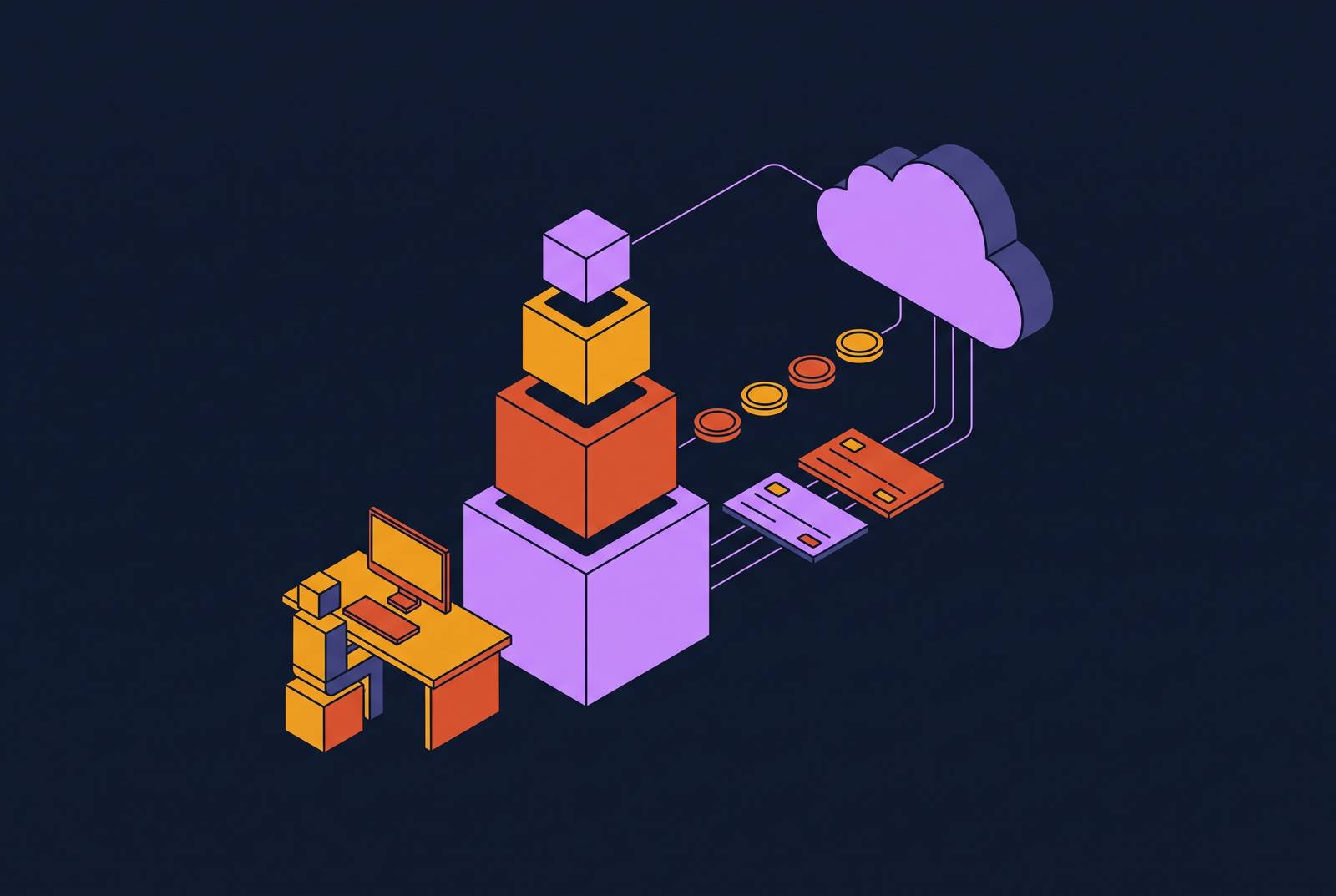
AI coding agent subscription true cost per developer includes the seat license and the cost of usage, human validation, and infrastructure. A bring-your-own API key cloud coding agent runner does not change that accounting requirement. Accurate budgets must include token consumption, debugging, review, onboarding, security remediation, and execution costs, which together can make the subscription a small fraction of total spend.
Why the subscription invoice is the wrong number to budget from
Traditional SaaS budgets treat a seat as a reasonably stable cost because users consume roughly the same service. Agentic tools measure work in tokens, and the amount of work they do varies widely from one developer to the next. An agent performing iterative tasks can read entire directories and rewrite multiple files before returning a result. The seat therefore establishes access.
That distinction makes usage distribution more important than headcount. A senior engineer running overnight pipelines and multi-file refactors can generate an order of magnitude more token spend than a junior using autocomplete. The distribution has a long right tail, so a small group of heavy users can pull the average well above what most developers consume. Without usage visibility, that spread remains hidden until billing exposes it.
What the headline plans actually cost across Claude Code, Cursor, and GitHub Copilot
Claude Code has individual plans for Pro at $20/month, Max 5x at $100/month, and Max 20x at $200/month. Team Standard costs $20–$25/user/month, while Premium costs $100–$125/user/month with a minimum of 5 seats and adds admin controls and SSO. For heavy users, Max subscriptions cost much less than raw API billing for the same number of tokens.
Claude’s API rates as of October 2026 price input/output per million tokens at $2/$10 for Sonnet 5.5, $4/$20 for Opus 5.5, and $10/$50 for Fable 5.1. Haiku 5.5 costs $0.10/$0.50, stepping to $0.50/$2.50 above 100K-token prompts. Cache reads cost $0.10/M on Sonnet 5.5 and $0.20/M on Opus 5.5. Those cached input tokens are 95% cheaper than cold inputs, making caching a major determinant of API spend.
Cursor offers Plus at $8/month for Grok models only, Premium at $30/month, Super at $100/month, and Ultra at $200/month. Teams starts at $30+/user/month, and Business costs $40/user/month and comes with SSO and RBAC. BugBot automated code review costs an extra $40/user/month, which is as much as a Business seat. Cursor uses a credit pool, with Auto mode effectively unlimited and higher plans raising a ceiling that remains in place. The Grok-only restriction makes Plus a different proposition for teams requiring other frontier models.
GitHub Copilot offers Pro at $10/month, Pro+ at $39/month, Business at $19/user/month, and Enterprise at $39/user/month. Enterprise also needs GitHub Enterprise Cloud at $21/user/month, which brings the price to $60/user/month. Copilot transitioned to token-based AI Credits on June 1, 2026, while code completions remained free on paid plans. Agent mode and premium models consume monthly credits, and the stated overage is $0.04 per premium request above plan limits. The extra Business credits offered through August 2026 hid what teams would have to pay once the promotion ended.
What engineering teams actually spend once agents run at scale
Anthropic’s data on enterprise use shows that Claude Code costs an average of $13/developer/active day and $150–$250/developer/month, with most users spending less than $30/active day. That monthly average is already far more than the $20 Pro subscription. Engineers who make heavy use of agents can run up API costs of $500–$2,000/engineer/month.
Task shape explains part of that spread. A single agentic task can send 400K to 2M cumulative input tokens through the API, and output and repeated loops use still more tokens. Power users run two to five times base subscription cost through agentic usage and overages. The heaviest GitHub Copilot users saw agentic bills jump by an order of magnitude after the June 2026 billing switch. Model choice matters, but the amount of work an agent repeats matters too.
At 1,000-developer scale, an all-in planning range is roughly $200–$500 per developer per month once seats, supporting infrastructure, and governance overhead are included. A $39 Enterprise seat can attract $150/month of agentic usage and an allocated platform cost, becoming a $250 line. These figures come from different mixes of usage, so the same multiplier will not fit them all. Their common feature is that the subscription no longer predicts the total.
How Microsoft and Uber lost control of their AI coding budgets
Microsoft’s Experiences & Devices division began rolling out Claude Code to about 5,000 engineers in December 2025. Adoption reached between 84 and 95 percent of that cohort by April 2026. The pilot charged a flat rate per seat, which hid how many tokens engineers used in its early months. When billing shifted to usage-based pricing, per-engineer API costs were $500–$2,000/month, and the annual AI tools budget was exhausted in a matter of months. Executive Vice President Rajesh Jha directed engineers to migrate to GitHub Copilot CLI by June 30, 2026.
Uber began its rollout to roughly 5,000 engineers in late 2025. Usage grew from roughly a third of engineers in February 2026 to a large majority classified as “agentic users” by March, with close to all engineers using AI tools monthly by April. Roughly 70 percent of committed code originated from AI tools by spring 2026. An internal leaderboard ranked teams by how much they used AI tools, so their score tracked token volume regardless of how much useful work they produced. After its budget was exhausted ahead of schedule, Uber imposed per-engineer caps of $1,500/month and began metering headcount growth against expected AI productivity.
Uber’s COO Andrew Macdonald acknowledged the unresolved connection between adoption and product results. He said, “That link is not there yet. Maybe implicitly there's more that is getting shipped, but it's very hard to draw a line between one of those stats and 'Okay now we're actually producing like 25% more useful consumer features.'” Microsoft and Uber had different adoption dynamics, but the budget failure shared a root cause. Adoption outpaced governance, and neither deployment had timely per-engineer spending visibility sufficient to prevent the overrun.
The five cost layers that compound the subscription fee into true TCO
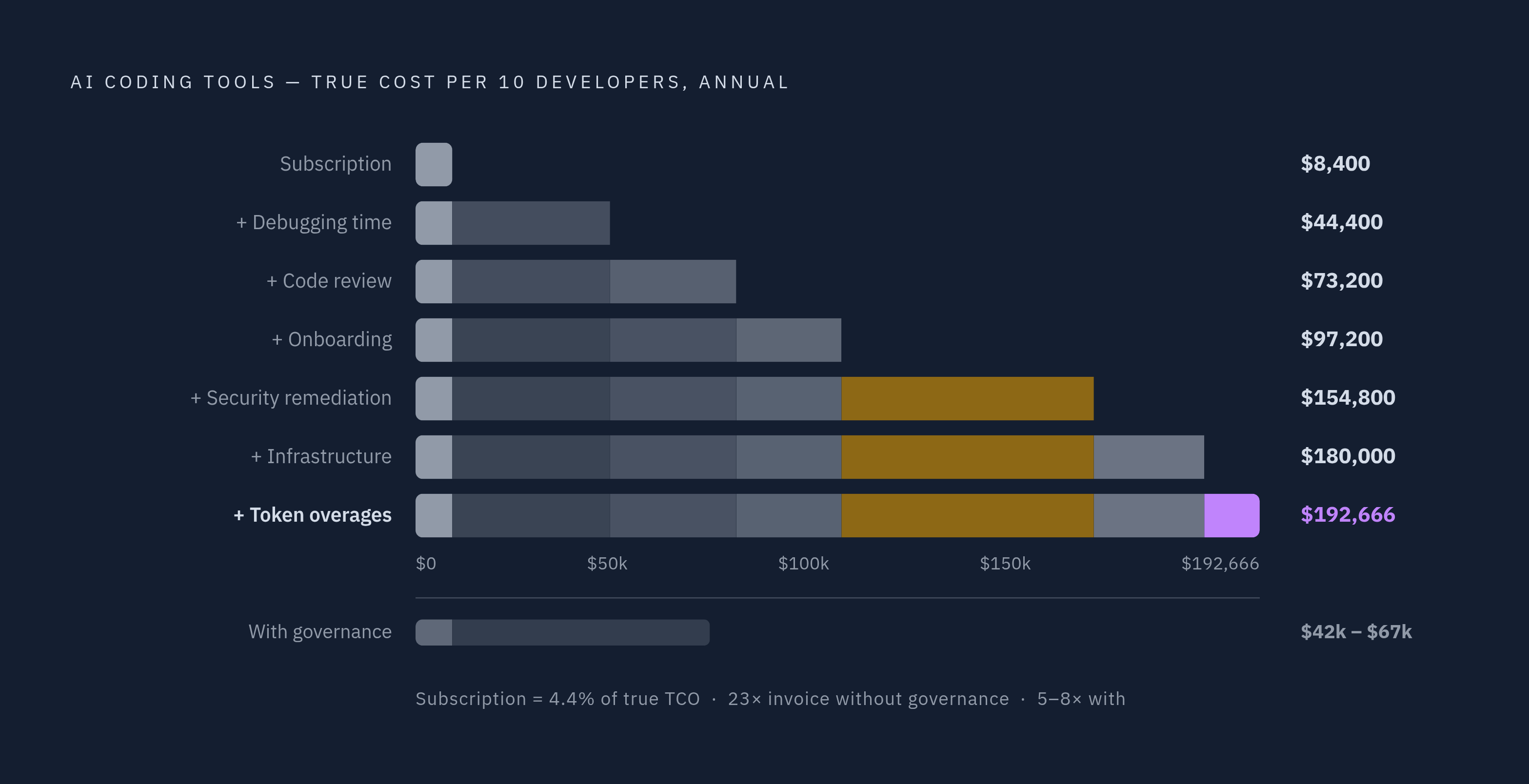
Metered tokens are the first cost layer and the one visible on the vendor invoice. Five other costs bring the full model to six categories. Debugging comes next because people still have to check code even when it is quick to produce. In the 10-developer team analysis, debugging AI-generated errors ran well into the tens of thousands annually. That labor is part of the cost of producing usable code, even when it sits in the salary budget.
Review compounds the debugging burden as multi-agent orchestration produces more pull requests and larger changes. Longer reviews can turn human attention into the new bottleneck. Training and onboarding also cost money because teaching takes time and people get less done at first. Security remediation then adds the work of finding and fixing flaws, including OWASP Top 10 vulnerabilities. These costs take up engineers’ time but stay off the AI vendor bill.
Infrastructure completes the model through gateways, MCP servers, observability tooling, and sandbox environments. Charging those services to a platform budget does not remove them from AI coding TCO. The 10-developer example paired $8,400/year in subscriptions with $192,666 in total ownership cost, roughly 23x the invoice. Subscriptions represented less than five percent of that total. Debugging, review, and integration overhead, along with token overages, accounted for the gap.
Governance can reduce that multiplier by controlling what is accepted and how much work is generated. With acceptance thresholds, AI code review checklists, and token budgets for each developer, the cited planning range comes to five-to-eight times the subscription cost. For the same 10-person subscription budget, that means $42,000–$67,200/year. These figures serve as planning examples, with actual outcomes varying by team. Their practical lesson is that governance belongs in the cost model as a way to control downstream work.
What productivity data actually shows, and why it complicates the ROI case
DX’s research across more than 400 organizations over 14 months found a median PR throughput gain of roughly 8 percent. Most organizations see measurable throughput impact in a 5–15% range, and agentic workflows take three to six months to show measurable gains. Those improvements can justify investment, but they are not order-of-magnitude gains. Subscription-only cost estimates paired with vendor productivity benchmarks therefore misstate both sides of the return calculation.
A randomized controlled trial found that experienced open-source developers took longer to finish tasks when they used AI tools, including Cursor Pro with frontier models. Developers who expected to work faster still believed afterward that they had been faster. Perceived speed is therefore not a substitute for measured task performance. Even elite teams with high usage and fast PR cycles report longer reviews and larger pull requests.
At TELUS, teams created more than 13,000 custom AI solutions and shipped engineering code 30 percent faster with governance and a structured rollout. The contrast supports building the investment case from internal evidence. AI increases output volume more reliably than it reduces time per task, while token billing grows with that volume. If review capacity stays fixed, some of the throughput gain is consumed by the queue awaiting human approval.
Why the environment agents run in determines both cost and code quality
Where agents run affects both security risks and how much work they leave for reviewers. Every task needs a sandbox with an isolated filesystem, network namespace, and compute allocation, with zero access to the host system. Agents run effectively untrusted code, so a failure should remain inside the sandbox. Project context helps agents do better work inside that isolated space.
A useful environment includes the repository, dependency graph, test suite, CI configuration, deployment manifests, and environment variables. With a cloned repository and full tooling pre-loaded, an agent can install packages, run services, drive a browser, and verify work before returning a pull request. Those checks leave fewer errors for engineers to deal with. Replicas provides one such execution architecture, running Claude Code, Cursor, Codex, and Opencode in isolated cloud environments triggered from existing workflows. Its pre-loaded dependencies and tooling let agents test their work, though token use for each task still depends on API rates and how complex the task is.
Enterprise controls remain part of the expense even with managed execution. Required controls include SSO integration, audit logging connected to security monitoring systems, secret scanning on agent PRs, PR policy gates, license governance, sandbox isolation, and incident response runbooks. Each has setup and maintenance costs that belong in TCO. A verified pull request offers a bounded, testable review surface with some verification already completed.
How to build a per-developer cost model that accounts for every layer
Start with observed token spend. Claude Code’s /cost command and GitHub Copilot’s credit dashboards provide tool-level data for establishing that baseline. Segment developers by usage profile, separating multi-file agentic work and overnight pipelines from autocomplete and occasional chat. Budget the distribution. Then add debugging, review, onboarding, security remediation, and allocated infrastructure costs to each profile.
Review time needs an explicit allowance because rising AI-assisted output does not create more reviewer capacity. Set per-engineer token caps before adoption scales and integrate them into the agent platform’s configuration. Pair those limits with acceptance thresholds, AI PR review checklists, and structured onboarding. These controls address both the amount of generated work and the effort needed to accept it.
Finally, attribute every run to its source, harness, model, credential, and output so that productive spend can be separated from waste. Execution platforms, including Replicas with its detailed analytics, can provide the attribution needed to compare agent and model combinations across work types. Keep the budget harness-agnostic so tasks can move to the model that fits their cost and quality requirements. Multi-harness support makes it easier to switch, while token rates and task complexity still affect the cost. Measurement and flexibility make the investment defensible because they turn a subscription purchase into a cost structure the team can actually manage.