Bring-Your-Own API Key Versus Managed Credentials in Cloud Agents
Choosing between BYOK and managed credentials is an architectural decision.
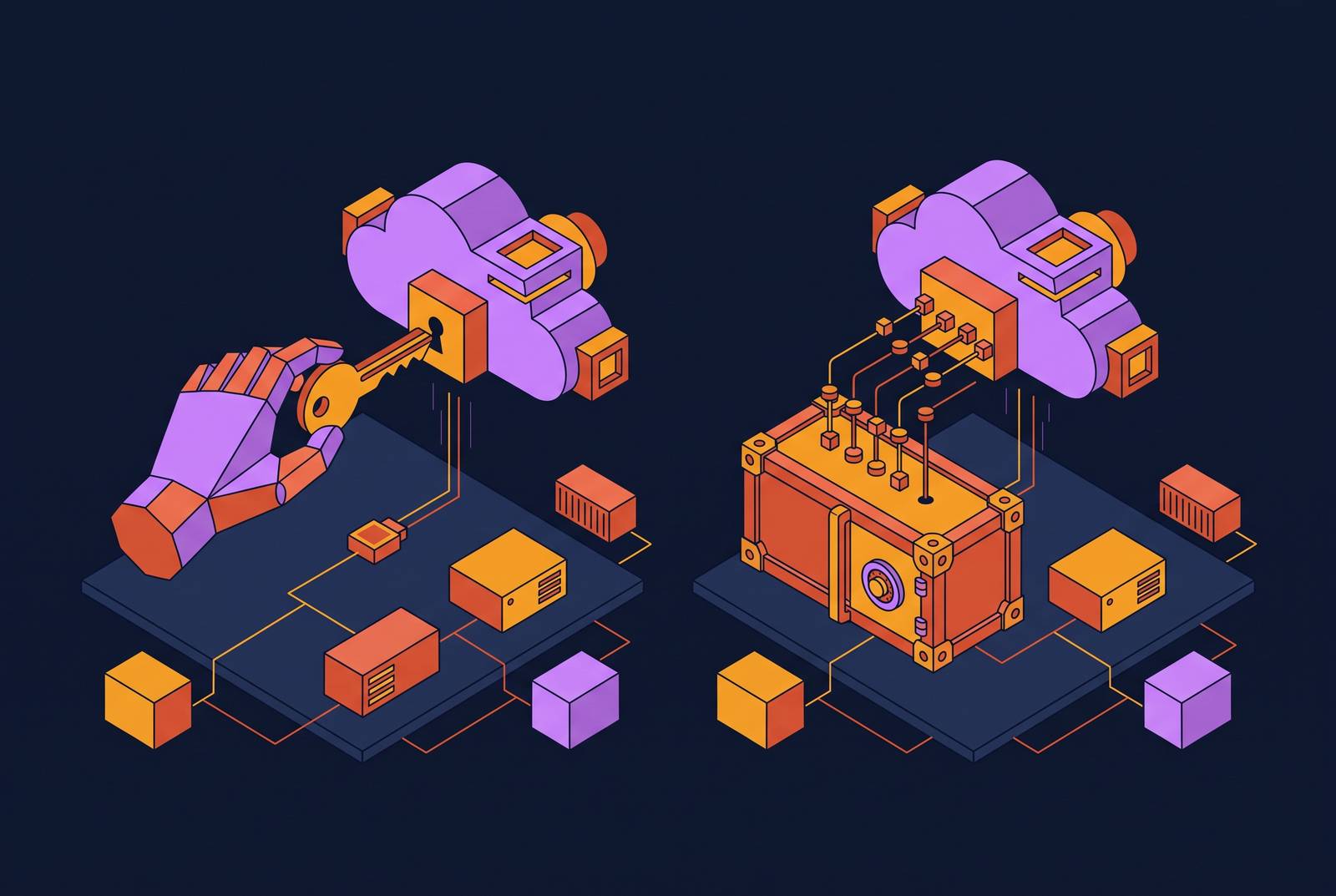
An agent process and the code it writes share the same address space, the same environment variables, the same filesystem. Whatever the agent can read, the code it generates can read too, because nothing separates the two at runtime. That single fact is why the choice between bring-your-own-key (BYOK) and managed credentials matters more than most teams assume when they first wire an agent into their cloud accounts. It is not a billing preference. It governs whether secrets, scope, and audit records are built into how the agent runs or bolted on after something has already gone wrong.
The default path most teams take is simple: put the API key or cloud credential into the environment where the agent runs, and move on. None of this is a prompt-engineering failure that better instructions could have prevented. It is a structural property of how the agent, its tools, and its credentials occupy the same space, and the only way to change the outcome is to change the architecture.
BYOK in practice
BYOK lets a developer connect a personal account with a model provider so usage bills to that account directly through that account's own metering. Warp's implementation shows what this looks like when it is done carefully. API keys for Anthropic, OpenAI, or Google are stored only on the user's device, in the OS keychain or an equivalent secure store, and never land on Warp's servers. When a request needs to go out, the local client pulls the key from device storage and sends it to Warp's backend in flight; the backend agent harness uses it once to call the model provider, then discards it without ever writing it to disk server-side.
That design has one firm boundary: BYOK does not apply to cloud agents. Warp separates this cleanly from two other features that sound similar but carry different trust properties. Each of these three tiers, BYOK, custom endpoints, and BYOLLM, solves a different problem and should be evaluated on its own terms.
None of this makes BYOK the wrong choice. At that point a team is not choosing between BYOK and managed credentials anymore. The architecture has already made the choice for them.
The five ways giving agents direct cloud credentials fails in production
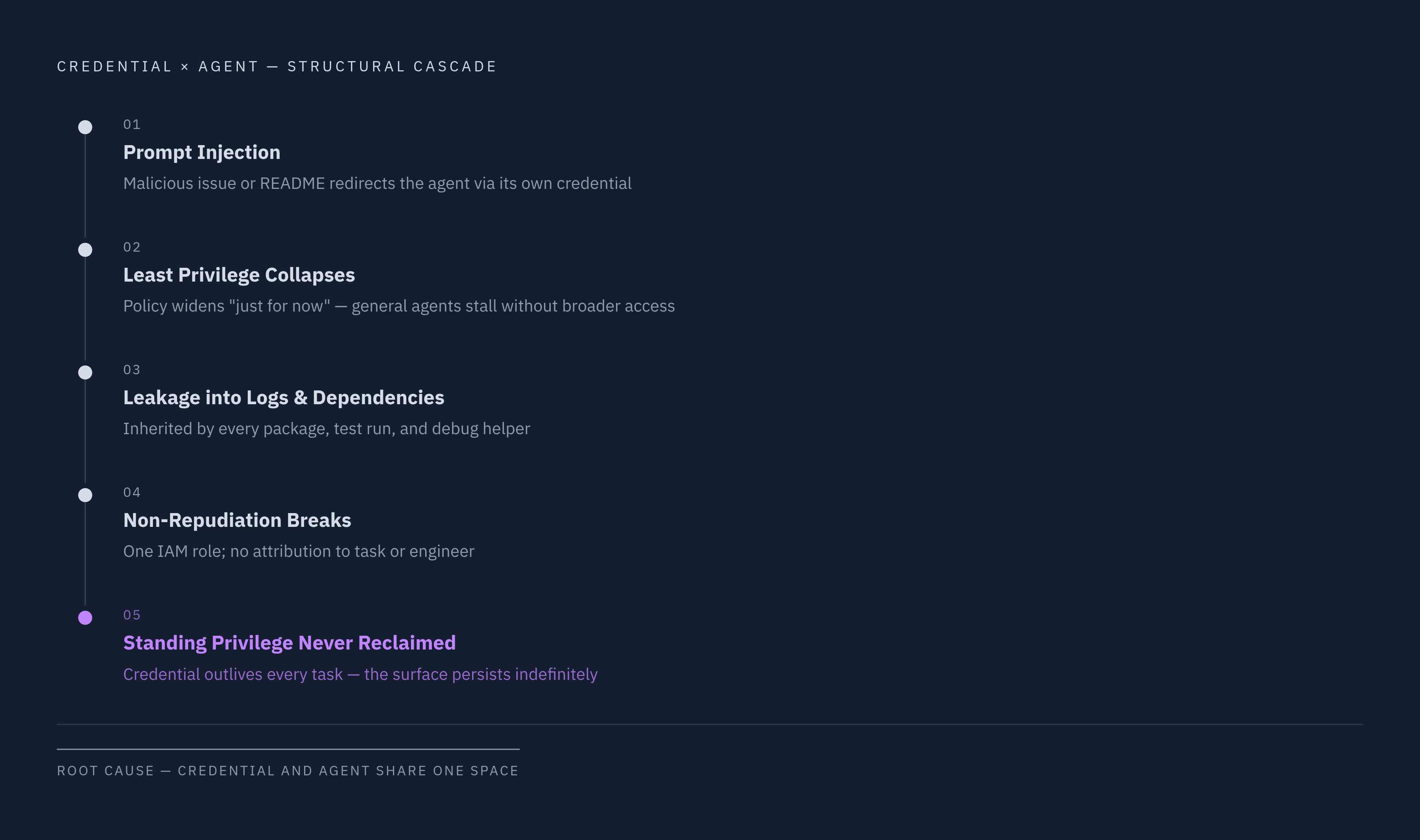
Handing an agent a raw, long-lived cloud credential and trusting it to behave is a bad default for a reason that has nothing to do with the model's intelligence. Agents act at machine speed, and they lack the instinct a human has to pause when a plan starts to look wrong. Five distinct failure modes occur when that credential sits directly in the agent's reach.
The first is prompt injection turning the credential into an attack surface. An agent that reads a GitHub issue or a README while holding cloud credentials can be redirected by content it never expected to treat as instructions. A CTO gave Claude Code an AWS access key so it could handle deploys. Nothing broke in production, but the CloudTrail log showed a single IAM role responsible for all of it, with no way to tell which task, which prompt, or which agent run had caused the activity. This maps directly onto two categories in the OWASP LLM Top 10: prompt injection (LLM01) and excessive agency (LLM03), both of which become far more dangerous once broad credentials sit behind them.
The second failure mode is that least privilege collapses once the agent becomes general-purpose. Write it narrow enough to be safe, and the agent stalls on routine tasks until an engineer widens the policy "just for now," a phrase that rarely gets revisited.
The third is leakage into logs and dependency trees. A credential sitting in the agent's environment gets inherited by every package it installs, every test it runs, and every debug helper it writes along the way, with no boundary stopping that inheritance.
The fourth is a breakdown in non-repudiation at scale. When one IAM role covers every agent action across a team, there is no way to attribute a specific outcome to a specific task or engineer, exactly the gap the CloudTrail example exposed.
The fifth is standing privilege that never gets reclaimed.
What a managed credential architecture controls
Managed credentials are often described as the safe alternative to BYOK, but that framing skips a step. Whether a managed system is actually safer depends entirely on where the private key lives, whether the credentials it issues are scoped and time-bounded, and whether every action produces evidence that can be reviewed later. Calling something "managed" says nothing on its own about any of that.
Two separate layers do two separate jobs here, and conflating them is where most of the confusion sets in. The first layer is the deployment API or internal developer platform, which narrows the agent's vocabulary down to application-level verbs: deploy, promote, roll back, create or destroy an environment. A GitHub Actions or GitLab CI pipeline can be triggered by the agent, but the pipeline itself holds the cloud credential, ideally a short-lived OIDC token. Under this model, the agent never holds a cloud credential at all, so the blast radius of any single run is bounded by design rather than by a policy someone has to remember to enforce.
The second layer is the machine-identity and secrets broker, whether that is HashiCorp Vault, Aembit, KeyRunner, an identity governance platform like Linx Security, or a secrets manager like 1Password. They do not restrict what the agent is allowed to deploy. They reduce how dangerous the credential is if something goes wrong while the agent is using it.
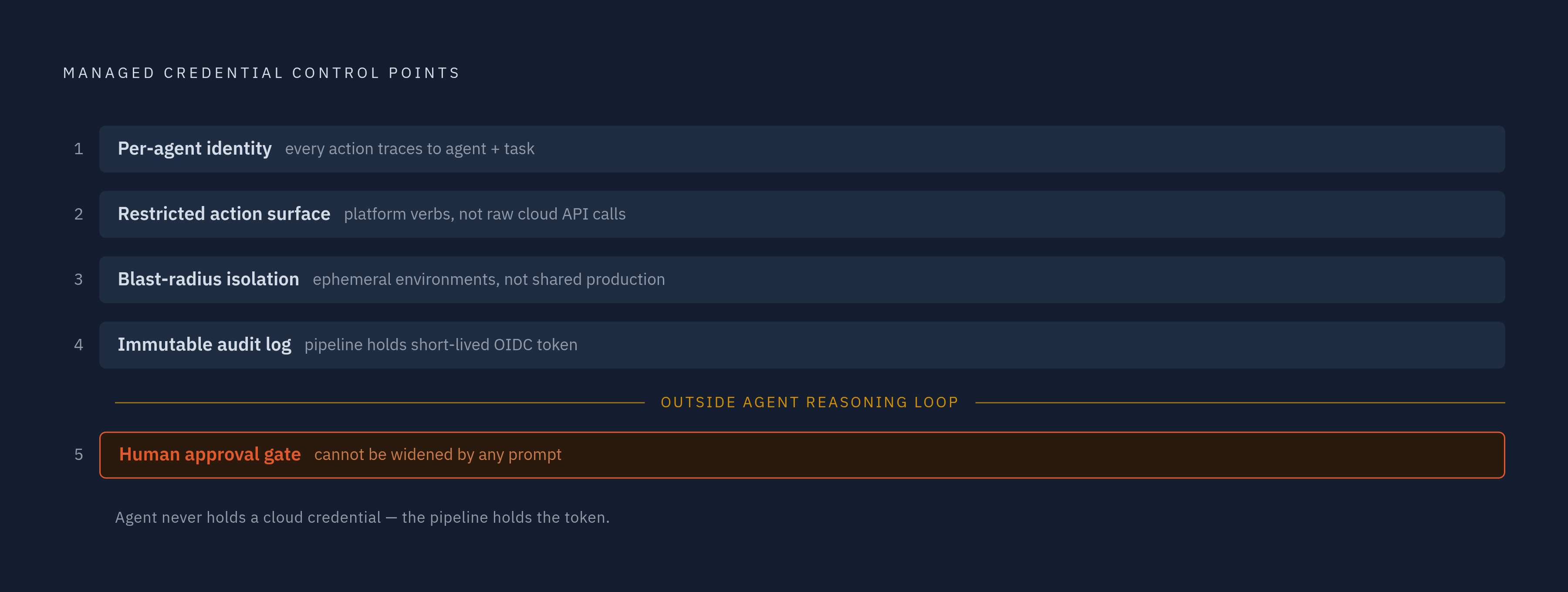
A managed system that actually holds up under pressure rests on five control points: per-agent identity, so every action traces to a specific agent and task; a restricted action surface built from platform verbs rather than raw cloud API calls; blast-radius isolation through ephemeral environments rather than shared production access; an immutable audit log; and a human approval gate before anything reaches production. These five controls sit outside the agent's own reasoning loop. No prompt, malicious or accidental, should be able to widen them from the inside.
Platforms that run agents in isolated sandboxed environments build the credential model into the architecture from the start: what a given task can reach is set by how secrets are provisioned into that sandboxed environment, not patched in after the fact. That isolation boundary is what turns the credential model from a policy someone has to enforce by habit into a property the system enforces by construction.
What the "zero-knowledge" claim guarantees
Some vendors offering fully hosted, managed-credential products describe their system as "zero-knowledge," meaning they claim to have no visibility into the credentials their own platform handles. For a fully hosted product, that claim is not technically possible, and engineering teams evaluating a platform need a precise way to test it.
Genuine sealing works like this: the runtime generates a keypair, publishes the public half, and the control plane stores only an encrypted blob it cannot open on its own. The distinction that decides whether this guarantee is real comes down to one question: does the control plane hold the private key or not? In a fully managed deployment, where the vendor operates the machine that holds the private key, the vendor can technically decrypt the data whenever it chooses, and no amount of X25519 encryption in the architecture diagram changes that fact. The cryptography is identical in both cases; only the trust boundary moves. Any vendor claiming zero-knowledge for a product it fully hosts is describing something that does not hold up.
Five questions separate real credential architectures from marketing claims quickly, and they are worth running against any platform under evaluation. Does the model provider key ever enter the environment where generated code actually executes? If it does, every other control downstream of that point is sitting on a hole. And what is actually present in the sandbox's environment, since inherited environment variables remain the single most common way a credential ends up exposed by accident.
The harness's handling of credentials changes the security posture regardless of which model runs
The harness running an agent matters as much as the model behind it, and two agents calling the identical model can carry entirely different security postures depending on how their harness manages secrets and network access.
Codex Cloud's handling of its Slack and Linear integrations illustrates one disciplined approach: secrets are encrypted at rest and injected only during a setup phase, then stripped out before the agent phase begins, and the network defaults to offline during execution. That offline default exists specifically to block exfiltration during the exact phase when generated code is running and capable of making outbound calls on its own. Claude Managed Agents, which entered public beta in April 2026, takes a broader platform approach: sandboxed code execution, checkpointing, credential management through Vaults, scoped permissions, MCP connectors, and tracing, all exposed through a public API. Claude Code itself supports sandboxing through Bubblewrap on Linux and Seatbelt on macOS, enabled through the /sandbox command or the sandbox.enabled setting. That sandboxing is opt-in rather than default, so most Claude Code deployments today, including most CI/CD integrations, run unsandboxed unless a team turns the setting on deliberately.
A team moving from local BYOK on a developer's laptop to cloud-hosted agents does not just change who gets billed. It inherits a different trust boundary entirely, and which harness it picked determines what defaults it is accepting on day one, whether or not anyone on the team read the sandboxing documentation closely enough to notice.
What auditability requires structurally, beyond billing-level logs
Knowing which agent run, triggered by which task, using which model and which credential, produced a given output requires that identity be assigned to each agent and each run before the work starts. Billing logs were never built to answer that question, so that attribution cannot be reconstructed afterward from a billing dashboard.
A real audit trail needs five components bound together and exportable: the acting identity, meaning which agent performed the action; the connection, meaning which credential was used; the specific tool or action invoked; the outcome; and a timestamp. Not every platform provides this at parity across its pricing tiers, which matters once a team is relying on the record for a security review.
The production pattern that makes this kind of trail meaningful in practice gives agents unrestricted write access to ephemeral, non-production environments, while production itself stays behind a propose-only gate that a human has to approve. Sandboxing and governance are often treated as the same concern, but they answer different questions: sandboxing controls where the agent is allowed to run code, governance controls what it is allowed to ship, and both need their own controls and their own place in the audit trail.
The Replicas approach to analytics maps onto this requirement directly: attribution extends down to the source, the harness, the model, and the credential for every minute an agent runs. That level of granularity is what lets a team measure what actually shipped, not just what was spent, which is the gap a billing log alone can never close.
Making the decision deliberately, a framework for choosing between BYOK and managed credentials by team context
Three variables settle which credential model fits a given team: whether agents run locally or in the cloud, whether they run synchronously with a developer present or asynchronously overnight, and whether security or compliance review demands per-agent identity and an immutable audit trail.
BYOK remains the right model for individual developers or small teams below the threshold where enterprise plans and security reviews come into play, running agents locally with a developer present for every session. It also suits privacy-conscious builders who want direct control over which provider receives their data and how the bill is split, and it works fine for any team that has not yet pushed its agents into asynchronous or parallel execution.
Managed credentials become necessary the moment any of several conditions apply. And any agent that touches production needs the safest default pattern available: unrestricted write access to ephemeral non-production environments, paired with propose-only access to production behind a human approval gate.
Most teams do not discover BYOK's limits during a security review. Planning the credential model before scaling agent usage avoids having to rebuild the whole security posture under pressure, after something has already run without the right controls in place.
For teams running agents across more than one harness, Claude Code, Codex, Cursor, Opencode, from a single control plane, the credential model has to work the same way across all of them rather than favoring whichever harness was set up first. Replicas addresses this by sandboxing every agent run in its own VM, scoping credentials to that individual run, and attributing every minute of usage to its source, harness, model, and credential through its analytics, which makes the managed credential model the structural default rather than something a team has to enforce by hand across every tool it adopts. As teams add harnesses and run more agents in parallel, the credential model chosen early either scales with that growth as a property of the system itself, or becomes the bottleneck everyone has to work around.