Prompt Injection Risks in Agentic Coding Pipelines
Architectural flaws make prompt injection inevitable in coding agents with credentials.
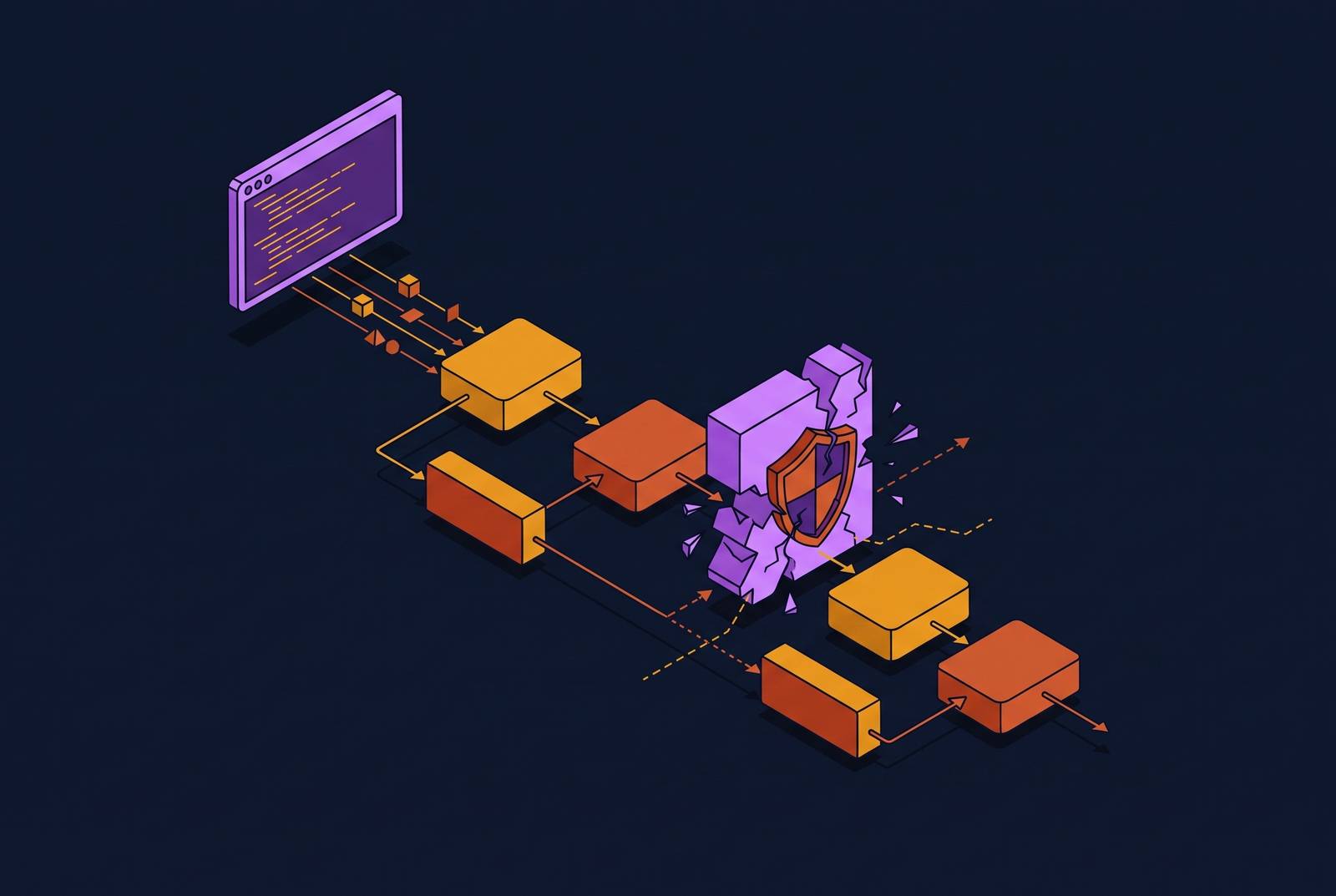
Prompt injection risks in agentic coding pipelines arise from giving models authority over systems while they read untrusted text. They are not simply configuration errors. Because models cannot reliably separate instructions from data, the dependable defense is architectural containment around what an agent can read, execute, and exfiltrate, with human approval for irreversible actions.
Why prompt injection is structurally unavoidable in agentic coding pipelines
LLMs process instructions and data within a single token stream, without an enforced security boundary between them. System prompts, user messages, retrieved documents, and tool results may have different chat roles, which function as formatting conventions. Text can cross the intended trust boundary. A passage retrieved for reference can influence the model as an instruction, with no memory-protection bit or syscall boundary preventing that change in authority.
NIST has characterized prompt injection as “generative AI's greatest security flaw”. OWASP ranks it the number one vulnerability in its LLM Applications Top 10 across three consecutive editions. Maloyan and Namiot's January 2026 Systematization of Knowledge paper describes the root cause as “architectural conflation of code and data” and calls for architectural-level mitigations. The distinction is between changing behavior and enforcing limits. Retrieval, fine-tuning, prompt engineering, and filters can change what the model sees or follows, but they do not supply the missing trust boundary.
What changed when coding agents gained credentials and tools
A chatbot that follows a malicious instruction may give an answer the user did not want. A coding agent can act on that instruction through filesystem access, shell privileges, and CI/CD credentials. The same weakness now reaches infrastructure directly. Credentials, tools, and autonomy can turn a text-level hijack into a deployment, a deletion, or a supply chain compromise.
The Model Context Protocol has become the de facto standard for connecting LLMs to external resources, and each tool server added gives attackers more of the attack surface to reach. OWASP identifies excessive agency as an amplifier of this risk because an agent's independent authority determines the impact of a successful injection. The Kiteworks 2026 Data Security and Compliance Risk Forecast Report found that 63% of organizations could not enforce purpose limits on their agents, 60% could not shut down a misbehaving agent quickly, and 55% could not isolate their AI systems from sensitive networks.
At the same time, the attack prerequisite has fallen. An adversary who previously needed write access to a trusted repository may now need only the ability to open an issue or pull request. Any free GitHub account provides that entry point. The attacker supplies text, while the pipeline supplies the authority to act on it.
The injection vectors that are already live in engineering pipelines
GitHub metadata is a direct route into agent context. Cloud Security Alliance's June 2026 analysis documents “Comment and Control” attacks against Claude Code, Google Gemini CLI Action, and GitHub Copilot Agent. These systems processed PR titles, issue bodies, and HTML comments as authoritative prompt content, enabling theft of live API keys and repository credentials. The payload entered through ordinary collaboration surfaces.
MCP tool description poisoning uses another source that agents expect to find in their context. The trust placed in tool descriptions is part of a wider trust relationship that can also let executable code in. Adversa AI's TrustFall disclosure on May 7, 2026, demonstrated automatic execution of project-defined MCP servers after folder-trust acceptance across Claude Code, Cursor CLI, Gemini CLI, and GitHub Copilot CLI. That acceptance did not separately disclose that code execution would occur.
The Beyond the Payload research examines coding agents bootstrapping projects from third-party repositories whose integrity cannot be assumed. The attacker need not control the user's prompt. Repository material supplies the indirect input, while the delegated task shapes how the agent encounters it.
CLI command composition makes the resulting behavior harder to judge one command at a time. Research on these attacks describes individually benign commands combining through shared operating-system state into an exploit path outside the user's intended task. The dangerous capability emerges from their interaction. An injected instruction need not request an obviously destructive command to be effective.
Fake package documentation and typosquatted sites extend the surface beyond the repository. They put material that attackers control where an agent expects to find technical guidance for its task. The trust boundary fails when the agent lets that reference material guide its actions, even though it is untrusted task data.
What the documented incidents show about blast radius
Clinejection on February 17, 2026, began with a single malicious GitHub issue title [1][2][3][4][5][6]. It triggered a chain of four vulnerabilities that produced an unauthorized supply chain compromise of the Cline AI coding tool's npm package. The malicious package reached an undisclosed number of developer and CI/CD systems over approximately eight hours before removal. Repository write access was not required at entry.
The Claude Code GitHub Action permission bypass disclosed in June 2026 showed another way to gain more authority. A successful injection directed the agent to read /proc/self/environ, exposing all environment variables in the workflow process. Among those variables were the OIDC token request credentials ACTIONS_ID_TOKEN_REQUEST_TOKEN and ACTIONS_ID_TOKEN_REQUEST_URL. They could be exchanged for a Claude GitHub App installation token, enabling the attacker to push code to the action's source repository. The process environment became the bridge to repository access.
Anthropic patched the primary authorization bypass within four days of disclosure. However, the underlying pattern of agents ingesting untrusted repository data while holding elevated pipeline credentials remains prevalent across the industry. Aikido Security identified at least five Fortune 500 companies with configurations consistent with that pattern as of mid-2026. The entry point and the damage had different privilege levels. That mismatch, rather than the wording of any individual payload, is what containment must break.
Why filters and prompt-level defenses cannot contain this class of attack
Filters are an appealing response because they are cheap and familiar from defenses against SQL injection. Yet that comparison obscures the central difficulty. A coding agent must make sense of open-ended language in material that may also hold hostile instructions. A filter must judge intent without an enforced separation between task data and executable authority.
Maloyan and Namiot's meta-analysis of 78 studies found that adaptive attack strategies succeeded against state-of-the-art defenses at rates exceeding a large majority. Most of the 18 defense mechanisms analyzed achieved less than half mitigation against sophisticated adaptive attacks. Input filters, output sanitizers, and stronger system prompts remain probabilistic defenses against an adversary who can adapt the payload.
Cursor's .cursorrules file guides what the model attempts, but is processed without validation and does not prevent attempts at restricted operations. The operating system does not enforce its instructions. Policy expressed inside the agent's context is therefore vulnerable to the same context manipulation it is supposed to constrain. Enforcement that depends on the agent's cooperation is not enforcement.
The deterministic controls that actually contain the damage
Engineering teams should begin containment with credential scope. Every agent should be treated as a confusable insider, given only the permissions its task requires and isolated from unrelated sensitive credentials. Tool calls should be audited like those of a privileged service account. In the action bypass, removing unnecessary OIDC credentials from the agent's environment would have broken the exploit chain. Authority withheld cannot be recovered by persuasive text.
Execution isolation then limits what a compromised run can reach. One VM per agent run, pre-loaded with only the required dependencies and credentials, prevents access to secrets staged for another run. Inside that boundary, OS-level policy enforcement sets what resources an action can reach, whether or not it goes through the expected tool layer. Tool-call interception alone cannot cover those indirect paths.
ActPlane, implemented as eunomia-bpf in 2026, illustrates enforcement below that layer. It uses eBPF to enforce policies in the OS kernel, with an information-flow control DSL, semantic feedback, and isolation. It helps enforce policy on indirect execution paths that tool-call interception cannot see, with 1.9% runtime overhead. A syscall forbidden by kernel policy does not happen because the agent has been instructed to attempt it.
Human approval gates should govern irreversible actions, including production-branch pushes, package publication, and payments. The agent must not be able to satisfy its own gate. A PR-as-output workflow has a structural advantage here because it produces a diff for engineering review before merge, rather than executing changes in real time with only a prompt confirmation. Approval separates proposing a change from authorizing its effect.
MCP governance should apply the rigor of production code review to tool configuration. The Sandworm_Mode campaign exploited its absence when rogue MCP servers were accepted after mimicking trusted utility names. ETDI's proposed cryptographic identity and immutable versioning address tool squatting and rug-pull attacks, but are not yet a deployed default. Organizational review must supply that control in the meantime. Harness selection completes this defense by matching tasks to security posture and environment privilege, rather than assigning one harness indiscriminately to every context.
How the PR surge makes undetected injection more likely to ship
How much teams can review is part of the security boundary. Linear's cross-company dataset tracked 6,887 teams for two years and found that teams using a coding agent went from roughly 21 pull requests a week to 65, while teams without one went from 8 to 10. Engineering time spent on triage, comments, and review increased. More output therefore arrived with more review work. This is a security condition, not an argument that agent-generated PRs are inherently defective.
Faros AI's report draws on two years of telemetry from tens of thousands of developers across thousands of teams. It found that median code review time and median time to first review both rose substantially under high AI adoption. Where AI usage is highest, reviewers take more than 16 hours to pick up agent-generated PRs. LinearB's benchmarks also show substantially larger agent-generated PRs at the high percentile. Larger diffs offer more space in which injected changes can escape attention.
LinearB's 2026 data shows autonomous agents merging within 30 days at a meaningfully lower rate than human-only pull requests. That finding identifies friction in the review path on which human detection depends. Linear reports that AI authored close to half of everything created in its system by volume as of August 2026, compared with fewer than one in a thousand issues two years earlier. Review-as-defense holds only if review quality survives that volume pressure. Architectural controls limiting what a compromised agent can do before review are more reliable than assuming reviewers will catch everything.
Building the pipeline posture that holds as agent use scales
An operating model that lasts treats prompt injection as something that will always be present, like untrusted network input. Every run that reads a PR, issue, web page, or package readme should be treated as a run that may have been compromised. Pipeline design must account for what remains reachable afterward. This shifts the goal from guaranteeing correct interpretation to minimizing the impact of a wrong one.
Under that model, each run gets short-lived, task-scoped credentials, with no shared long-lived tokens or ambient access to other tasks' secrets. It pairs those credentials with a fully configured VM boundary so that shared execution state cannot undermine isolation. Detection alone cannot provide the same separation. Sophos found that legitimate coding-agent actions, including browser automation, can be semantically indistinguishable from credential-theft patterns to endpoint detection engines.
Within those boundaries, tool calls, file reads, shell commands, and network egress should be logged with attribution to the source task, harness, model, and credential. Exfiltration controls need a logged boundary. Attribution also supports investigation when no immediate artifact exposes the injection. Without it, an external credential transfer or an unauthorized change that passes review may remain undiscovered long after the run ends.
Finally, MCP changes should pass through standard pull request review, while sensitive tasks should be routed to harnesses with mandatory confirmation and sandboxed MCP servers. These practices complement OS-level enforcement. Tool choice is part of security policy. Because the attack surface is built into the system and each tool's security posture changes over time, the pipeline should stay harness-agnostic so it can switch agents without rebuilding its containment model.
Sources
- AI Agent Prompt Injection: The New CI/CD Supply Chain Threat
- [2601.17548] Prompt Injection Attacks on Agentic Coding Assistants: A Systematic Analysis of Vulnerabilities in Skills, Tools, and Protocol Ecosystems
- Prompt Injection Attacks on Agentic Coding Assistants: A Systematic Analysis of Vulnerabilities in Skills, Tools, and Protocol Ecosystems
- Beyond the Payload: How User Invocation Shapes Coding Agent Vulnerability to Repository Poisoning
- Assessing Automated Prompt Injection Attacks in Agentic Environments
- ActPlane: Programmable OS-Level Policy Enforcement for Agent Harnesses