License Ownership and Cost Attribution When Slack Triggers a Claude Code Pull Request
Slack-triggered Claude Code work splits login, billing, and blame.
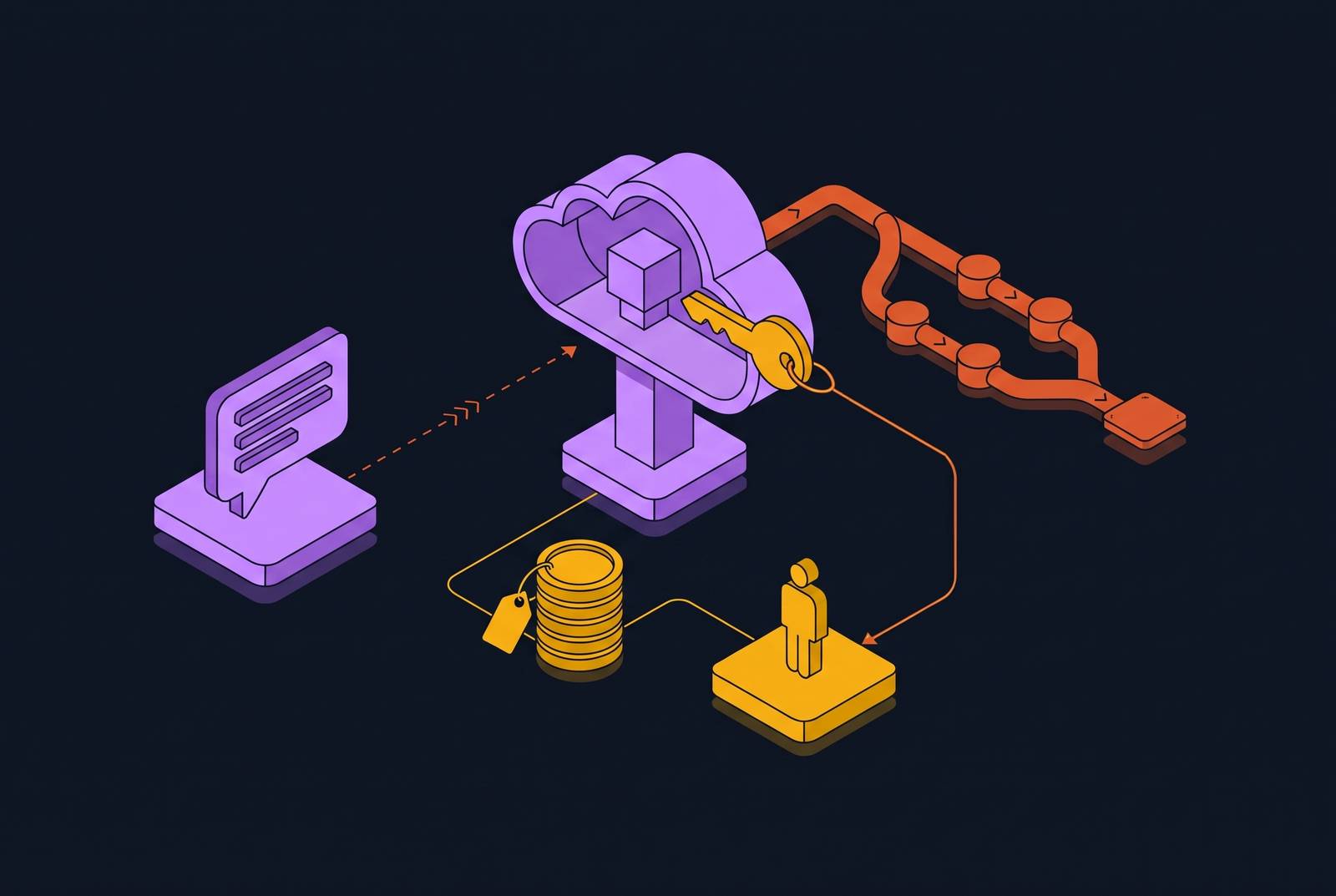
To run Claude Code in the cloud from Slack, a team member @-mentions Claude, starting a session in an Anthropic-managed VM without managing that infrastructure themselves. The resulting pull request uses a GitHub App identity. License ownership and cost attribution therefore require three separate decisions before scaling this workflow, namely which account authenticates, which subscription or API key pays, and which human is accountable.
What happens when you run Claude Code in the cloud from Slack
A Slack @-mention activates three distinct system actors. The Slack integration receives the message, the Claude Code cloud session starts in an Anthropic-managed VM, and the GitHub App identity will eventually open the pull request. The channel is the entry point. Work moves from a conversation into a cloud session and then into a repository artifact.
Each actor has its own credential, usage attribution, and audit trail, so the visible Slack conversation is only one part of the record. The person requesting the work is identifiable in the channel, while the session and repository operate through their own identities. None of those system identities is automatically the person who typed the message.
The three questions that collide at the moment of trigger
Authentication, the first question, establishes the account under which the agent runs and the credentials presented to GitHub, the repository, and downstream tools. The second is cost, which establishes the subscription or API key that absorbs token usage. It also asks whether that route changes with the way the session starts or the model it uses. The third is accountability, which identifies the team or individual responsible when a charge arrives or a pull request produces a security finding. These questions address separate aspects of ownership.
The answers can point to different people or systems. The Slack sender may request the task, a team seat may own the Claude subscription, and a billing administrator may have established the workspace. Treating the sender as the answer to all three questions conceals the distinction between requesting work and authorizing the resources that perform it. Likewise, knowing who gets the bill does not tell the team who should approve a code change. The framework separates these decisions so that authentication can be examined first, billing second, and human responsibility against both.
Which account authenticates the agent session and opens the pull request
The session uses its Claude subscription or API key to authenticate. In the shared-channel scenario, that is almost never the account of the person who typed the message. For subscription-backed work, the paid seat’s owner is the accountable authenticating party, regardless of who initiated the task.
Repository authorship is a distinct part of that arrangement. The GitHub App identity opens the pull request, rather than the Slack sender’s personal GitHub account. This follows the app-identity pattern in shared-channel agent integrations, where pull requests, issues, and comments carry the app’s identity.
Code review assignment, CODEOWNERS triggers, and branch protection rules may work in unexpected ways when the author is an app identity. Those configurations require an audit before scaling shared-channel use. Claude Code is included in Pro, Max, Ultra, Team, and Enterprise plans, but not Free, so subscription-backed Slack sessions draw on a paid seat rather than acquiring an entitlement from the sender’s Slack access.
How the subscription and billing structure determines who gets the token bill
The subscription attached to the authenticated session normally determines which allowance absorbs its usage. Claude Code has no standalone pricing. Coworker’s September 2026 breakdown explains that Claude chat, IDE usage, and Claude Code share a usage pool on the same account. A morning of Slack-triggered sessions can therefore reduce the allowance available for a developer’s afternoon terminal work.
For leaders comparing seat types, the decision turns on expected volume and the limits that constrain it. Pro costs $20/month, with a lower rate when billed annually, and has both a rolling five-hour window and a weekly cap. Max costs more per month and allows several times as much Pro usage under both limits. Ultra has a higher monthly price still and provides 10× Pro usage per week, with no five-hour limit for verified accounts. The relevant distinction is allowance as well as price.
Team Premium seats allow much more usage per session than Pro and cost more per month. Enterprise instead has a per-seat annual price with a 20-seat minimum, while usage is billed at API rates without a per-seat cap. It has SCIM, audit logs, and spend limits for each user and organization. Enterprise makes token cost calculable, but attributing that cost to a particular Slack sender still requires workspace-level instrumentation.
Two billing mechanics can change the expected route. If usage credits are enabled, using up an included allowance leads to overflow charges at standard API rates, so a burst late in the week can add charges on top of the flat seat fee. More directly, an ANTHROPIC_API_KEY environment variable overrides the subscription even when a subscription login is present. Every token then bills to that API key. An unintended key can therefore redirect charges to a different account without changing who appears to have requested the work.
Why the shared usage pool makes per-person cost attribution the hardest problem
Within the same subscription pool, Slack-triggered usage and a developer’s direct terminal usage are indistinguishable for attribution without additional instrumentation. That creates a governance gap in chargeback, budget ownership, and anomaly detection. It is a consequence of shared subscription architecture. The account is the unit of allowance, while the organization may need the task or person to be the unit of responsibility.
Central billing adds another layer of aggregation. On Team and Enterprise plans, the administrator sees workspace-level charges rather than a per-trigger breakdown unless session-level logging connects sessions to their initiating Slack messages. On plans with a five-hour rolling window, a session can also consume capacity that a developer expected to use later that day. The consequence may appear first as an interrupted task. Dollar totals alone do not show why that allowance has been used up.
Teams have three concrete ways to recover visibility. Dedicated Team or Enterprise agent seats keep Slack work out of developer usage pools, so teams can see the agent’s total cost but still cannot tell who made each request. API key routing through a Claude Console key with per-workspace spend limits exchanges subscription allowance for per-token billing and granular usage analytics. Session metadata tagging preserves the triggering user’s identity in session metadata or PR description context so logs can correlate shared-account activity with a person. These options address different gaps, and none by itself resolves every attribution question.
What accountability actually means when cost and identity do not align
When the authenticating account, billing recipient, and Slack sender differ, responsibility defaults to the seat administrator unless the organization establishes another rule. That is rarely the right owner for a task requested by a developer or product manager. Administrative control is not approval of each change. The accountability framework must therefore distinguish the person who requested work from the person who accepts its output.
The identity gap also has a compliance dimension. A SOC 2 auditor reviewing agent-generated pull requests will look for a human accountable for each change. An app-identity author without session metadata tied to a named user leaves that requirement unresolved. To preserve the connection, agent-generated change requests should include the tool name and session ID in a machine-readable format. A marker such as agent:claude-code, paired with a session identifier, lets a security analyst trace a suspicious PR back to its session and initiating Slack message.
Human review is the point where responsibility becomes explicit. Every agent-generated PR should require a human to merge, comment, or send it back, and no session should auto-merge without human approval. This checkpoint becomes especially important when a product manager or designer can initiate code changes from Slack, because the requester is no longer necessarily a developer. Attribution at trigger must therefore pass the sender’s identity into the session and PR description. Tamper-evident retention of session logs, prompt-response pairs, and PR metadata then preserves that connection for the period required by the applicable compliance framework.
How the framework changes when Slack-triggered agents run in parallel or on a schedule
Parallel sessions amplify the existing ownership questions. Each session on a shared seat draws on its own from the same five-hour and weekly allowances that apply to the seat, using them up faster than an estimate for a single session predicts. If usage credits are enabled, overflow charges can accumulate without a deliberate decision to approve the added spend. Concurrency turns an attribution ambiguity into a budget exposure.
For parallel work, the practical minimum is dedicated agent capacity with explicit spend controls. Dedicated agent seats separate this usage from developer seats, while Enterprise or API-key-based configurations provide limits against which administrators can monitor spending. Scheduled and webhook-triggered work needs another decision because no human necessarily sends a Slack message. The agent seat authenticates and the PR appears, but the accountability record depends on the session logs and metadata configured at setup. Responsibility must be assigned at the integration layer before the first run.
Platforms that isolate each session in its own VM provide a boundary between session credentials and context. Platforms that return a pull request for a human to review and approve add a separate boundary before merge. Both are relevant criteria for running agentic coding tasks without managing the underlying infrastructure. Neither boundary substitutes for the explicit identity and billing connections needed to attribute a session to its responsible owner.
A practical checklist for engineering leaders before scaling the Slack-to-PR pattern
For authentication ownership, provision a dedicated Claude Team or Enterprise seat, or a Claude Console API key with a spend limit, separate from developer seats. For repository compatibility, audit branch protection, CODEOWNERS files, and review assignment against app-identity PR authors before the first protected-branch workflow. For billing credentials, inspect the session environment and retain only an intentionally configured ANTHROPIC_API_KEY, completing the checks that establish who can act and under which account.
The next decisions concern spend and capacity. Choose between a flat seat with usage-credit overflow and API-key-based metered billing based on how many sessions are expected each day and how much the team can accept in burst charges. Set the available workspace-level or per-user spend limits in Enterprise or Console API key configurations before enabling usage credits. On Team plans, assess whether Standard or Premium seats fit the expected workload, since moderate Slack-triggered activity may exhaust a Standard seat’s allowance.
The final decisions establish the human record. Configure the Slack integration to pass the triggering user’s identity into every session and every PR description or commit message the agent produces. Require a named human reviewer’s approval before any agent-generated PR merges. Keep session logs, prompt-response pairs, and PR metadata in a tamper-evident system with the triggering identity attached for as long as SOC 2 or the compliance framework in use requires. For scheduled work, name who is accountable at the integration layer before the work starts.
These are pre-flight decisions. Authentication, token billing, and human accountability collide as soon as a Slack message starts the session. The time to resolve them is before that trigger and before the first unexpected bill or audit finding.