Cloud Agent Platforms That Wire GitHub Linear and Slack Triggers to Isolated VMs and Deliver Pull Requests Automatically
Engineer teams need cost visibility and accountability across automated code tasks.
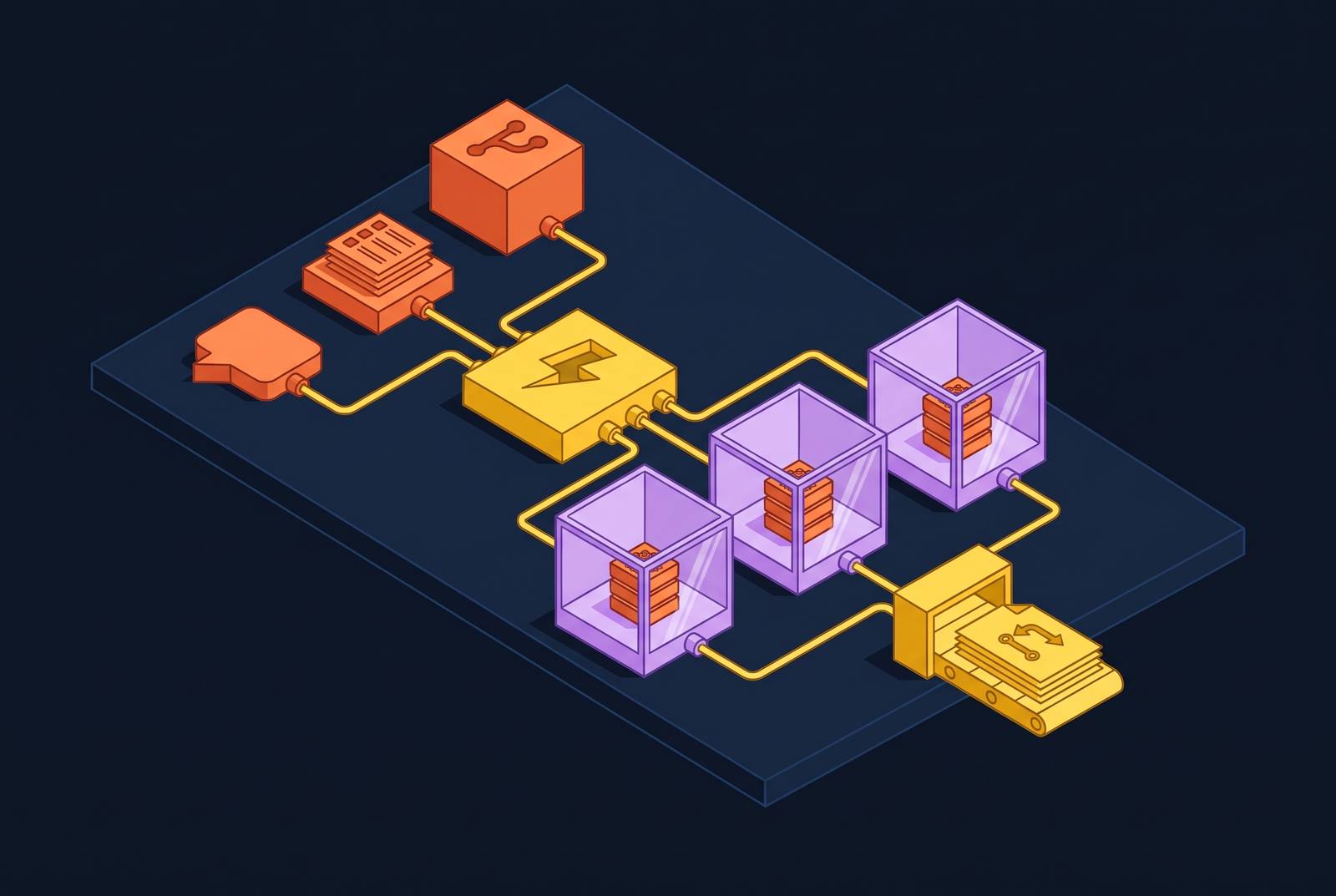
Per-run agent cost attribution for engineering teams requires connecting each task’s cost to its source, initiating engineer or team, harness, model, and credential, with that information available beyond billing. For teams using Claude Code or Codex, model charges alone do not establish responsibility. Cloud platforms that turn GitHub, Linear, and Slack triggers into pull requests must therefore be evaluated as four connected layers, namely trigger ingestion, sandboxed VM provisioning, agent execution, and PR delivery.
Why the trigger-to-PR pattern is a distinct architecture, not just an agent feature
An editor-based coding assistant can help an engineer write code without owning the environment in which that code runs or the process through which it reaches review. Bare sandbox infrastructure solves a different problem by providing somewhere to execute code. Neither one on its own can take delegated work from an existing work queue through to a pull request. A trigger-to-PR platform must link what the task should do, the conditions it runs under, how the agent works, and delivery without an engineer having to manage every handoff.
Local execution makes those handoffs seem simpler because a person fills in the missing context. Each run is tied to that person, their machine, and their permissions. That arrangement becomes restrictive when engineers need parallel runs, repeatable environments, isolation from other work, and records of responsibility and cost. The platform now has to provide them explicitly rather than inherit them from an engineer’s working environment.
The trigger layer determines which workflows can enter that pipeline. Its integration surface may include GitHub activity, Slack, Linear, an API, or a schedule, but those surfaces are not interchangeable. Claude Code supports scheduled routines, while Google Jules exposes a public API for wiring tasks into CI/CD pipelines and tools such as Slack and Linear. Native integration and API-based wiring are different adoption paths. A narrow trigger surface can force a team to move work into a new interface, while broader ingestion can accommodate where requests already originate.
That distinction also establishes the starting point for attribution. A task’s source and the person responsible for it belong to the delegation context. Evaluation therefore has to distinguish accepting a request from preserving enough context to account for the resulting run. Trigger breadth shows where work can enter, while attribution asks whether responsibility remains visible after that work leaves its original interface.
Sandboxed VM provisioning: what isolation actually means and why it matters per task
Once a request enters the system, provisioning determines what the agent can actually do. The environment includes repository files, dependencies, tools, credentials, and network access, each of which can enable or constrain execution. Isolation is part of that working environment. A container isolates processes, while a VM isolates the kernel. This kernel isolation has made VM and microVM boundaries common for agents executing arbitrary generated code. Per-task isolation also separates simultaneous work rather than placing every delegated task in one shared workspace.
Codex cloud makes the effect of provisioning explicit through its two-phase runtime. Setup installs dependencies with network access, and the agent phase then runs with internet access off by default, configurable per environment. Each task keeps its files, including uncommitted changes, and saved state is recoverable for up to seven days after the last turn starts or the task resumes.
Cursor cloud agents use a prepared Build that clones the repository, runs an install command, and saves a disk snapshot from which each agent VM starts. That snapshot defines the starting environment for execution. The agent can then test its work in the VM’s desktop and record screenshots and videos of its checks. Jules also clones the repository into a cloud VM and writes an execution plan that the user can review and edit before it runs. Devin provides each session with its own shell, browser, and code editor, and can divide large tasks across parallel agents in isolated VMs.
Cursor’s self-hosted workers run the processes that touch code on customer infrastructure and connect outbound over HTTPS, while orchestration, planning, and model inference remain in Cursor’s cloud. Claude Code Team and Enterprise organizations can route sessions to a self-hosted environment on their own servers. A self-hosted execution option must therefore be assessed by which processes remain local, while per-task VM provisioning determines how concurrent tasks stay separate.
Agent execution: how harness choice and model selection shape what happens inside the VM
The harness running inside a VM and the model it calls are separate choices, even when a product packages them together. The harness governs how the agent works with its environment, while model selection determines which model performs the reasoning. Coupling varies by product and subscription tier. Treating both as inseparable from the platform can create unnecessary lock-in, especially when different engineering workloads need different execution patterns.
Cursor illustrates how commercial packaging can constrain model choice. It includes its own models in the subscription and charges API list price for third-party models on Premium and above, with an additional Cursor Token Rate on Teams and Enterprise. Free and Plus have no third-party models. Opencode takes a different approach to selection. It has no model of its own, so users connect a provider or local server and run the model they choose.
Those differences affect per-run cost evaluation as well as flexibility. A model’s API rate is not necessarily the full charging basis for the platform running the task, as Cursor’s additional token rate illustrates. Choosing a harness also leaves open which engineer owns a run. Cost attribution needs both the execution choices and the delegation context. For shared use of Claude Code or Codex, the relevant question is whether the platform exposes those connections per task.
Harnesses nevertheless converge on several operating patterns, including terminal or command-line access, explicit planning, approval gates, external tools through the Model Context Protocol, and delegated or parallel work. Workload fit still differs within that common blueprint. Claude Code is stronger on long-context engineering and workflows that rely heavily on external tool integrations, while Codex combines an open-source CLI with stricter default sandboxing and cloud delegation. Cursor emphasizes inline pair programming and adds asynchronous cloud delegation from the editor, web, iOS, or Slack. Devin is more oriented toward autonomous asynchronous delegation, but is harder to observe mid-task.
Human checkpoints remain part of this execution architecture. They may take the form of permission prompts before file writes, network restrictions, or mandatory PR review before merging. The platforms described here share a boundary against pushing straight to a production branch unattended and have different approval paths. Harness-agnostic evaluation therefore means comparing both workload fit and the controls surrounding execution, rather than assuming model choice alone determines behavior.
PR delivery: what comes back, how review is triggered, and where the loop closes
Delivery returns delegated work to the team’s existing engineering process or creates another process to supervise. A pull request’s branch, review notification, CI permissions, and handling of follow-up comments define how execution reconnects with human work.
GitHub Copilot coding agent pushes commits to a draft pull request as it works and tags the requester for review when finished. It also picks up review comments as follow-up work, making review another input to execution. CI/CD has a separate approval boundary. By default, a person must approve its PRs before CI/CD workflows run, although administrators can turn off that requirement.
Cursor cloud agents open a pull request on a dedicated branch, with review and merging available from mobile. That delivery path connects asynchronous execution to a review surface beyond the editor. It does not, by itself, establish the same follow-up behavior as another platform. Teams need to assess each delivery mechanism on its own terms, including whether it fits their existing review workflow and how later requests for changes return to the agent.
Delivery is also where attribution becomes useful to engineering leaders. Knowing what ran and what it cost is different from knowing what shipped, and a completed run need not mean a merged change. Teams need to check whether they can still see the details of each run when they review its output. No billing total supplies that relationship on its own. Teams must assess the platform’s accounting and review tools together and check that they can find the cost details they need when reviewing a pull request.
How the four layers interact: what breaks when one is misconfigured
Things often break where layers meet, even when each feature works on its own. Codex’s default-offline agent phase makes the provisioning-to-execution dependency concrete. If setup leaves out a package that execution needs to fetch, the agent cannot install it without the required network access. That can produce a silent failure. The fault is not necessarily model performance, because the environment has already constrained the available actions.
Cached preparation creates a related dependency between the repository and execution environment. Cursor’s Build supplies the disk snapshot from which agent VMs start, so the install command is part of the task’s starting conditions. Review gates create another joint at delivery. Copilot’s default requirement for human approval before CI/CD runs means that a returned PR and a running validation workflow are not equivalent states.
Claude Code’s auto-fix, Jules’s CI detection, and Devin’s review-comment loop can turn delivery into another trigger. The pipeline becomes a cycle. Attribution must then be evaluated across that cycle, including whether subsequent work remains connected to its source and responsible person. A platform that returns a PR and one that responds to the resulting feedback expose different operational boundaries.
What to evaluate when choosing a platform: a layer-by-layer checklist
The practical evaluation is a set of questions applied to each layer, with answers grounded in the team’s workflow and deployment requirements. Trigger support comes first because it determines which work can enter. Which surfaces are native, including Slack, Linear, GitHub issues, GitLab comments, API, and schedule? Does delegation fit the team’s existing interface, or require a new one? Which integrations need extra wiring because the platform does not support them directly?
Does each task receive a VM or a container? Is network access in the agent phase open, default-offline, or configurable? Can execution run on customer infrastructure, and which processes still run in the vendor’s cloud? Is the environment defined and cached through a setup script, a disk snapshot, or both?
Can tasks use different harnesses and models according to workload, or is the platform locked to one combination? Does a session time limit truncate long-running tasks? Which human checkpoints apply before writes, execution, and merging? These answers distinguish model availability from the operational freedom to use it.
Does it respond to CI failures and review comments, or stop after returning a pull request? Does output enter the existing GitHub PR or GitLab MR process? Is each run attributed to its source, person, harness, model, and credential? Can engineering leaders access that information and its cost?
For per-run cost attribution, the decisive criterion is a task-level account of responsibility and expense across the whole pipeline. Broad triggers, isolated VMs, flexible harnesses, and automatic PRs do not individually establish it. A useful evaluation connects those capabilities to the same delegated task. That is what separates a collection of agent features from an architecture an engineering team can configure and account for reliably.